America 250: Why Acknowledging Providence Breeds Humility, Not Arrogance
This piece is the companion to Part 3 of the America 250 video series over on YouTube. The series walks through the historical moments themselves — this piece walks through what they mean. Watch the video first if you haven’t already, then come back here and let’s think through it together.
Introduction
Say it out loud in polite company: “I believe this nation was blessed by God.”
Watch what happens.
Someone will call you arrogant. Someone else will call you chauvinistic. Someone will mutter the word “xenophobic” under their breath and change the subject. In today’s conversation, claiming providence for your country is treated like claiming superiority over everyone else’s.
But here’s what you need to understand: that reaction has it exactly backwards.
Viewing history through the lens of divine providence doesn’t inflate the ego. It deflates it. Take the idea of providence seriously, and you can’t walk away arrogant. You walk away humbled. You walk away grateful. You walk away with a burden of responsibility you didn’t have before.
Let’s break down why.
Recognizing a Higher Power Deflates Human Ego
Here’s the logic, and it’s not complicated.
If you believe your nation survived its darkest hours and won its greatest victories because of divine intervention, you cannot simultaneously believe you did it all yourself. Those two claims cancel each other out. You don’t get to credit God and then turn around and brag about your own brilliance.
Recognizing that something bigger than us was at work is a safeguard. It’s a check on the ego before the ego gets out of hand. Take destiny seriously — really seriously, not as a slogan — and there’s no room left for swagger. No room for overconfidence. No room for xenophobia. The victory wasn’t self-made, so the credit isn’t self-claimed.
This is the part the critics miss. They assume providence is a trophy case for national pride. It’s actually the opposite. It’s a mirror that shows you how much you didn’t earn.
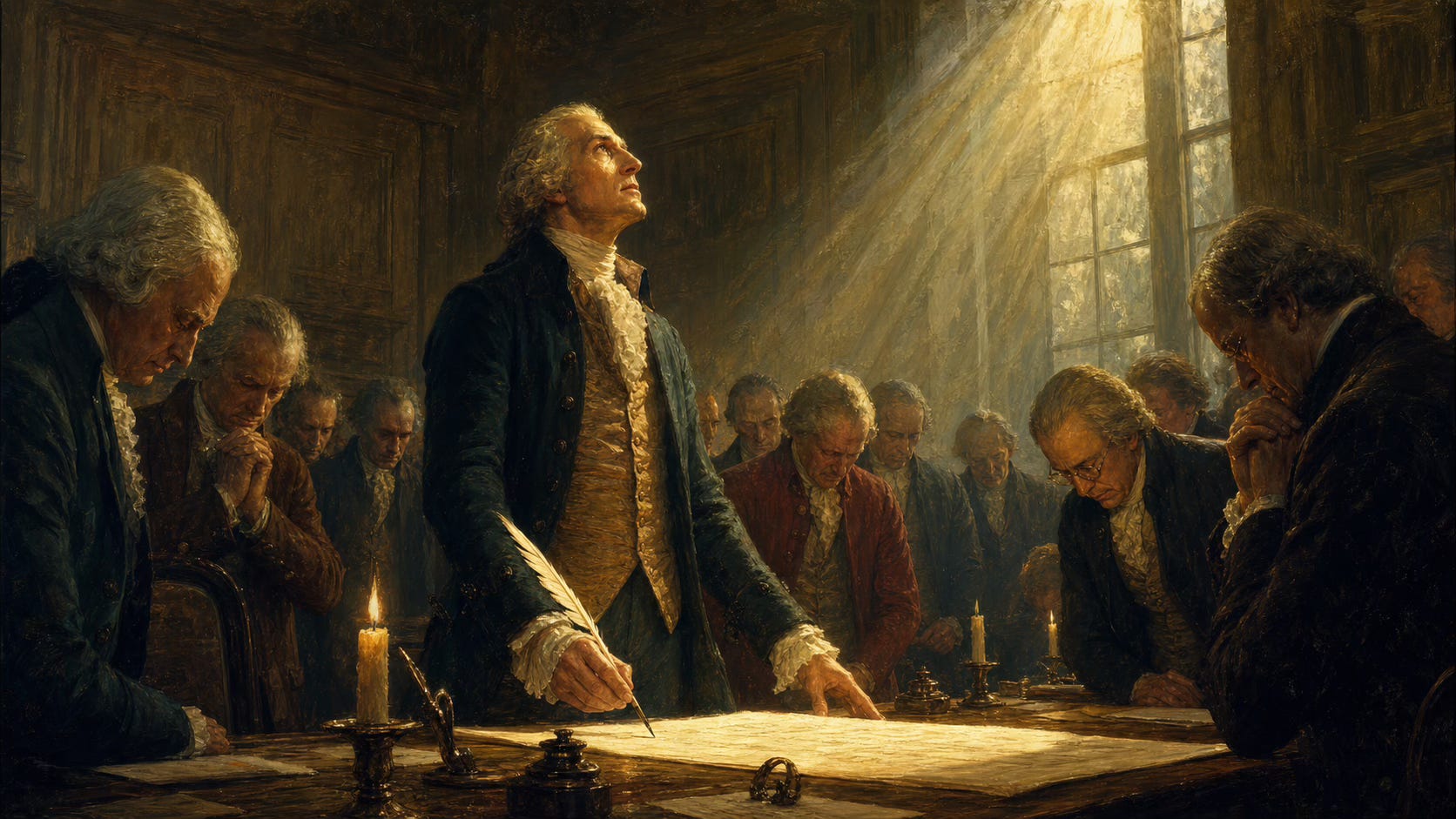
This is exactly how the founders themselves reacted. Not with arrogance. Not with chest-thumping about their own genius. With even more humility. The men who lived through the improbable birth of this country were the first to say, out loud and often, that they hadn’t pulled it off alone.
Michael Novak, the Catholic philosopher and theologian, makes this case at length in On Two Wings: Humble Faith and Common Sense at the American Founding. Novak’s argument is that the American founding rested on two wings working together — reason and faith — and that the founders themselves understood their success as something they couldn’t take sole credit for. Strip out the faith half of that equation, Novak warns, and you don’t just get a different account of history. You get a founding generation that suddenly looks a lot more arrogant than it actually was.
Separating Exceptionalism from Perfectionism
Now here’s where people get confused, and where you need to be precise.
Believing a nation is distinctively blessed does not mean believing that nation is flawless. These are two different claims, and conflating them is a mistake — a serious one.
Don’t confuse the reality of American exceptionalism with fantasies about American perfectionism. One is a claim about providence working through a people. The other is a fairy tale that ignores sin, ignores failure, ignores history as it actually happened.
Acknowledging a divine plan doesn’t excuse a single act of flaw, folly, or failure. It doesn’t erase the times this country failed to provide an unmitigated blessing to all its people. Slavery happened. Injustice happened. Betrayal of stated ideals happened, again and again.
What providence explains isn’t the absence of those failures. It’s the presence of purpose despite them. A flawed people, still being used for a higher purpose — that’s the claim. Not a perfect people incapable of wrong. Anyone who tells you those are the same thing is either not thinking clearly or not being honest with you.
Here’s the sentence worth remembering: a country can be great without being perfect. Those aren’t competing claims. Greatness was never about a spotless record. It was always about what a people do with what they’ve been given — how they repent, how they correct course, how they keep reaching for the ideals they haven’t yet lived up to. A nation that pretends it has no sins to answer for isn’t great. It’s blind. A nation that owns its failures and still keeps striving toward the higher purpose it was given — that’s the real thing.
Blessings as a Call to Accountability
If providence isn’t a trophy, what is it?
It’s a summons.
Providential blessing is not a free pass to do whatever you please. It’s the opposite — a heavy burden of responsibility. Ask any father who’s watched his children given more than they’ve earned: more is expected of the one who’s been given more, not less.
Historical miracles and interventions should be read as calls to accountability, not permission slips for arrogance. When a nation looks back and sees the hand of God in its survival, the correct response isn’t “we deserved it.” The correct response is “what do we owe now?”
Look at what happened at Brooklyn in August of 1776. Washington’s army was beaten, boxed in, and staring down total annihilation. The British had them pinned against the East River with nowhere to go. And then, overnight, a fog rolled in — so thick and so precisely timed that it covered the entire Continental Army as it ferried across the water to Manhattan, right under the noses of a British force that could have ended the war in a single morning. Michael Medved tells this story in The American Miracle, and it’s the same story referenced in the video companion to this piece. Call it luck if you want. Washington didn’t. He and the men who survived that night called it what it looked like: an act of mercy they hadn’t earned and couldn’t explain.
That’s the whole point of remembering. Acknowledging this history is meant to inspire citizens to act nobly and to correct the injustices of the past — to actually live up to the ideals a higher power apparently expected when He extended the blessing in the first place. Gratitude without accountability isn’t gratitude. It’s vanity wearing gratitude’s clothes.
Historical Role Models of Humility
You don’t have to guess what this looks like. You have an example.
John Quincy Adams watched something almost impossible happen. His father, John Adams, and Thomas Jefferson — two founders, two former presidents, two men who had spent years as rivals and then as reconciled friends — died on the same day. July 4, 1826. The fiftieth anniversary, to the day, of the Declaration of Independence.
If any man had reason to turn a coincidence like that into national swagger, it was John Quincy Adams. Instead, he did the opposite.
He called it “visible and palpable marks of Divine Favor” — and his response to that recognition wasn’t pride. It was submission. He wrote that it led him to “humble myself in grateful and silent adoration before the ruler of the universe.”
Read that again. Not “celebrate.” Not “boast.” Humble myself. Silent adoration. That’s the model. That’s what taking providence seriously actually produces in a man — not a chest puffed out, but a head bowed down.
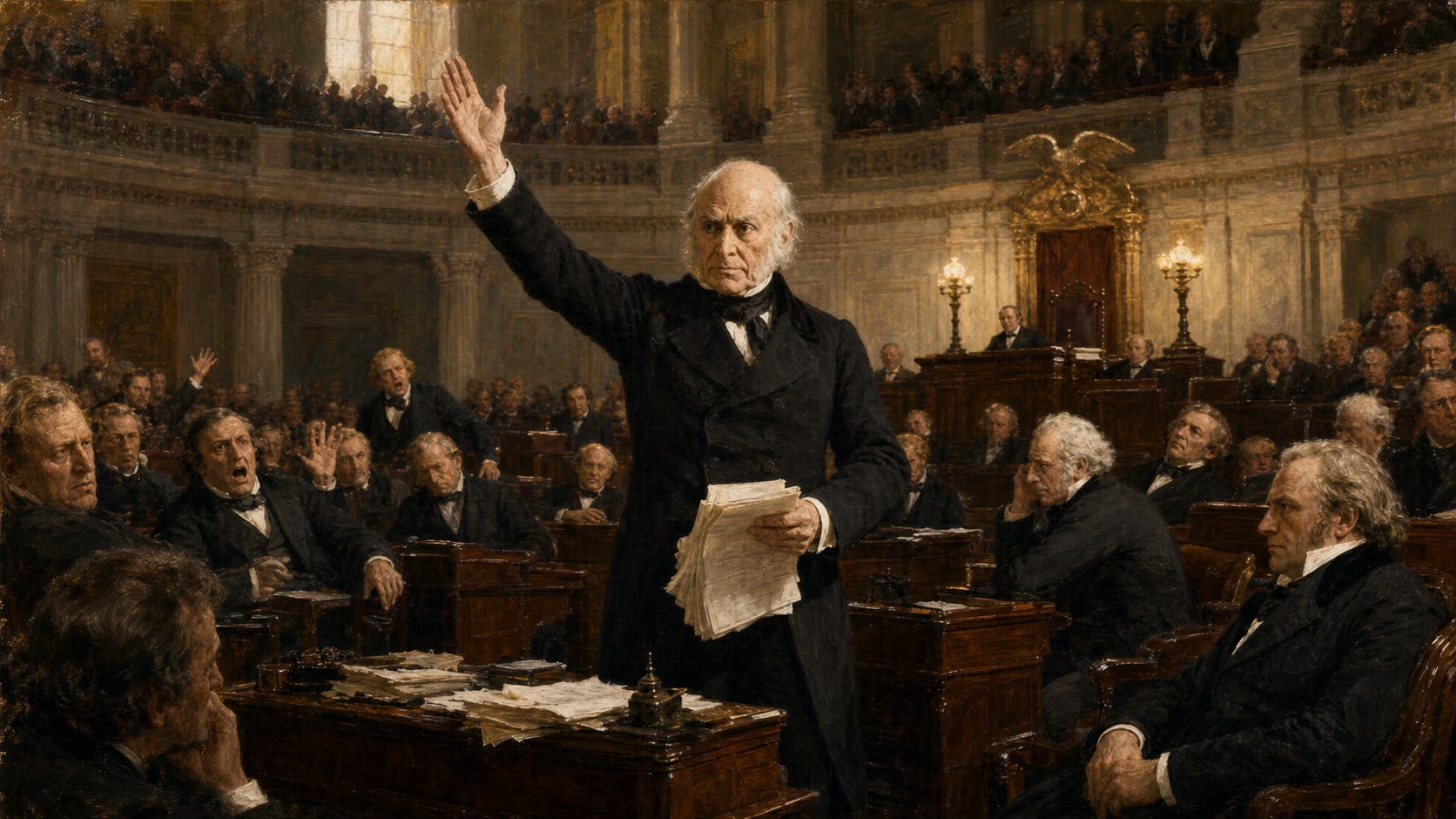
And Adams didn’t stop there. He’s the only man in American history to serve in the House of Representatives after serving as president — a step down in rank that most men with his résumé would have considered beneath them. He didn’t see it that way. He went back to work. For the better part of two decades, from the 1830s into his final years, he used that seat to fight the scourge of slavery, going toe to toe with the southern tiger at the height of its power. It cost him. It made him enemies. He fought the gag rule that tried to silence anti-slavery petitions in Congress, and he stood before the Supreme Court to defend the captives of the Amistad. He would win real victories in that fight — but he would not live to see slavery itself ended. He died in 1848, seventeen years before the chains finally came off. That’s not a footnote. That’s humility in action: a man who took a lesser office, fought a fight he knew he might not live to finish, and did it anyway because he believed it was owed.
Conclusion
Remembering the American Miracle isn’t supposed to make you arrogant about your achievements. It’s supposed to do the exact opposite — remind you how much of it was never yours to claim credit for in the first place.
So the next time someone hands you the “blessed nation equals arrogant nation” line, you’ll know better. The founders who saw providence most clearly weren’t the ones strutting. They were the ones on their knees.
Look at this nation’s blessings not as a trophy of superiority, but as a humbling reminder — to remain accountable, to remain responsible, and to remain deeply, silently grateful.
That’s not chauvinism. That’s the beginning of wisdom.
If you haven’t watched Part 3 of the America 250 series yet, take a few minutes and watch it. And more importantly, this Fourth of July, don’t be ashamed of your country. Celebrate it. Celebrate America 250. Gather with people you love, say a prayer of thanks, and pick up a good book while you’re at it.
Build a Flourishing Life: Read Better. Think Clearer. Believe Deeper.
Happy 250th Anniversary America!


