MOJO Academy Book Brief--Day 17 -- JFK and the Reagan Revolution
MOJO Academy Book Brief #10? -- JFK and the Reagan Revolution
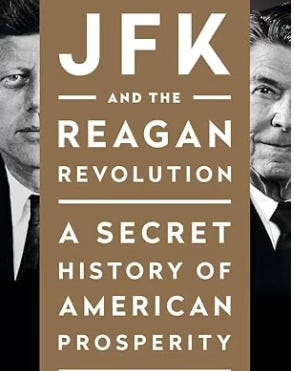
Book Title: JFK and the Reagan Revolution: A Secret History of American Prosperity
Authors: Larry Kudlow and Brian Domitrovic
Publishing Year: Sept 2016
Number of Pages: 256
Audible Time: Approximately 9 hours
Brief Summary
JFK and the Reagan Revolution by Larry Kudlow and Brian Domitrovic dives into the surprising connection between the economic policies of John F. Kennedy and Ronald Reagan. Even though they came from opposite sides of the political spectrum, both leaders took a similar approach: cutting taxes to boost economic growth. The book makes the case that Kennedy’s bold tax cuts in the 1960s paved the way for Reagan’s groundbreaking policies in the 1980s, creating a bipartisan playbook for economic prosperity.
Kudlow and Domitrovic challenge the idea that Democratic administrations always shy away from tax cuts. Take Kennedy, for example—he went against his Keynesian advisors and pushed through big income tax cuts, dropping the top rate from 91% to 70%. The result? One of the longest economic booms in U.S. history at the time. Fast forward to the 1980s, Reagan followed a similar playbook to tackle stagflation, and it led to one of the most prosperous periods in American history.
This book isn’t just a history lesson—it’s a fresh take on how free-market ideas could help tackle today’s economic challenges. It even dives into how, despite all the negative press, supply-side economics actually works. As Kennedy once said back in 1962, when discussing his tax cuts proposals, "a rising tide lifts all boats."
Two Important Quotes
#1—Empowering Economic Growth
"Like Reagan, Kennedy wanted Americans not to lean on government to limp through life but to go out in the economy and take a rip at the ball. If the government did not get in the way, Kennedy and Reagan believed that a wholesome general prosperity would come about, wiping away division and cynicism and engendering a national happiness. We badly need reminding of this ideal in these pitifully slow-growth years, a now nearly two-decade era of economic mediocrity that does not be fit this country and its traditions."
This quote highlights how supply-side economics stresses individual ambition and economic freedom as the key to prosperity. It champions minimal government interference, encouraging hard work and reigniting the entrepreneurial spirit that’s been a core part of the nation’s identity.
#2—A Bipartisan Legacy
“Both Kennedy and Reagan identified substantially cutting income tax rates and getting the dollar strong and stable as the specific policy mix that would let the private sector, which is to say the real economy, thrive.”
This quote illustrates the bipartisan significance of their policies, showing that economic growth transcends political divisions. It invites modern readers to reflect on how these timeless principles can address today’s economic challenges.
Nuggets of Wisdom!
I read this book back in October 2018, during a time when my views on Donald Trump were shifting—I went from being against him to supporting him. A big part of that change was seeing people like Larry Kudlow and other supply-siders join his team. We talk about this on our podcast, Liberty Minute #55—The Case for Trump
Reading JFK and the Reagan Revolution was a gift that just keeps on giving. Reason being, it shows two leaders-- two iconic leaders—JFK and Reagan—despite their differences in time and ideology, ended up with similar ideas about economic policy. I loved how the authors showed Kennedy’s growth as a leader, moving from relying on Keynesian advisors to taking bold action with tax cuts that really sparked American entrepreneurship. Reagan’s determination to stick to these principles in the 1980s was another great example of leadership—doing what’s right for the long-term, even when it’s not popular and not relenting in the face of strong economic headwinds throughout all of 1982.
This book really got me thinking about today’s economic challenges. Are we too stuck in our political camps to learn from what worked in the past? Kudlow and Domitrovic lay out a clear path to finding that bipartisan wisdom again—at least when it comes to economic issues, especially the kind that sparked some of the biggest booms in history. Kennedy didnt think so. but then again, JFK in the 21 century might certainly have been a republican. But that is a different book review to check out.
Here’s the takeaway from this book: we’ve got two solid examples of supply-side economics in action—one in the 1960s and the other in the 1980s. Both of these actually drew inspiration from the booming 1920s and how the U.S. economy started growing back then.
Final Recommendation
JFK and the Reagan Revolution is a must-read if you're into economics, politics, or American leadership. It’s especially great for policymakers, business leaders, or anyone curious about what drives economic prosperity and how to actually grow the US economy. The book explains supply-side economics in a super easy way that’s still totally relevant to today’s talks about growth and prosperity. I highly recommend it! Plus, it’s on Audible, so you can crush it easily!
If You Liked This Book, You Might Like These:
Taxes Have Consequences by Art Laffer offers a compelling and very, very well-researched look at how tax policies shape economic outcomes, making it a fascinating read for any nerds like me interested in fiscal policy and economic growth.
The Age of Reagan: The Conservative Counterrevolution by Steven Hayward dives into the life and impact of one of America’s greatest presidents. Packed with sharp insights and a gripping storyline, Hayward brings the transformative Reagan era to life in a way that’s both engaging and thought-provoking. You also get a behind-the-scenes look at how Reagan came up with and pushed for his supply-side economics, knowing it would be a game-changer.


