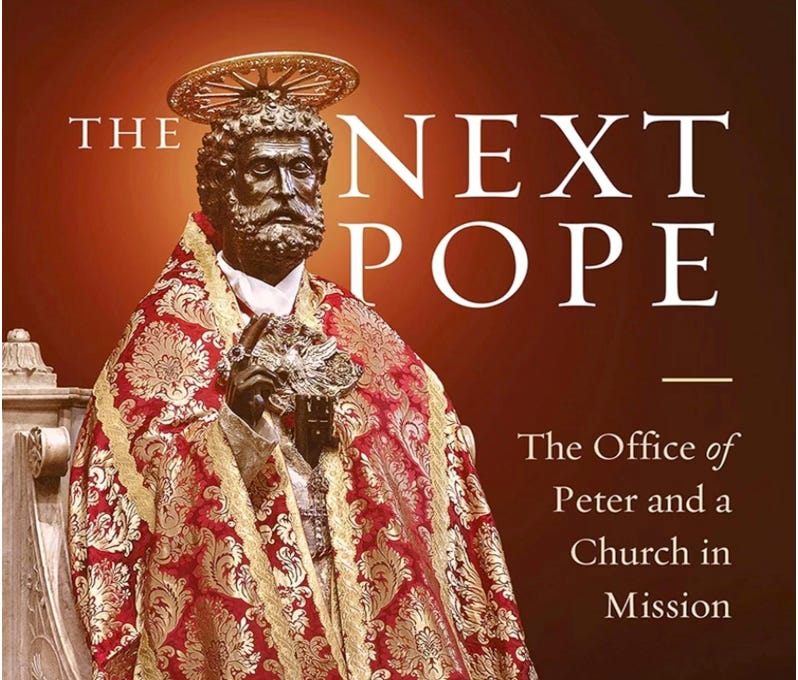
MOJO Academy Book Brief #21 -- The Next Pope by George Weigel
Book Title: The Next Pope: The Office of Peter and a Church in Mission
Author: George Weigel
Publishing Year: 2020
Number of Pages: 141
Audible Time: Approximately 4 hours
Brief Summary
The Next Pope by George Weigel takes a thoughtful look at the future of the Catholic Church as it prepares for a leadership transition. Weigel dives into the challenges and opportunities ahead for a faith community of 1.3 billion people, tackling big topics like secularism, globalization, and institutional struggles in a clear and engaging way.
As we await the election of a new supreme pontiff during this period of interregnum—the time between the passing of Pope Francis and the selection of the 267th successor to the Apostle Peter—we reflect on this significant moment in the Church's history and I thought this book would be an excellent book brief.
Weigel takes a fascinating look at the leadership of Popes John Paul II, Benedict XVI, and Francis, using their examples to lay out a vision for what’s needed in the next pope. He identifies ten key “qualities” and dives into each one in detail. At the heart of the book is a call for renewed evangelization, a focus on the differences between the thriving and struggling parts of the Catholic Church (his words are the "the living and dying parts"), and a push to re-center the Church as a “mission-driven” community. Weigel also emphasizes the importance of doctrinal clarity, moral boundaries, and much-needed reforms in the priesthood, episcopate, financial reform and the Vatican’s global role. The Next Pope finds a balance between critique and hope, serving as both a manifesto for the Church’s mission and a roadmap for its future leader. I recommend it highly!
Two Significant Insights
#1—A Man Not of the Second Vatican Council
"The next pope will likely have been a teenager or a very young man during the Vatican II years; he may even have been a child during those years. In any case, he will not have been shaped by the experience of the Council and the immediate debates over its meaning and its reception like John Paul II, Benedict XVI, and Francis."
This is a crucial point that many Vatican observers have overlooked in their lead-up coverage to this conclave. For over 60 years—since the conclusion of the Second Vatican Council on December 8, 1965—there has been an ongoing debate about the reforms proposed during the council and how those reforms have been implemented across the global Church. The next pope will undoubtedly be aware of these debates but is unlikely to have a deep emotional connection to them. For him, the Council and its events will have been just one of many background occurrences during his upbringing within the Church.
#2—Choosing One of Your Own
"Thus the next pope must insist on the Church's final authority in the appointment of bishops, anywhere and everywhere."
Back in 2018, under Pope Francis, the Church made a deal with the Communist government in China, giving up its authority to appoint bishops. Many thought it was a bad move at the time—and it hasn’t aged well. The agreement was renewed in 2020 and 2022, and now it seems like it might have been reaffirmed again, though details have been hard to pin down. Frankly, it was a bad deal.
Critics argue that letting the CCP—an atheist regime—pick candidates for the Church undermines the Vatican’s spiritual authority and ties it to a government that's notoriously hostile to religious freedom. Under this setup, only candidates loyal to the state are likely to be chosen, raising concerns about the Church’s independence.
The CCP’s “Sinicization” policy, which forces religions to align with Chinese identity and Communist ideology, has only been strengthened by this deal. It’s led to things like replacing Catholic symbols with Chinese ones, prioritizing loyalty to the state over faith, and even rewriting sacred texts like the Bible to reflect socialist values. By going along with all this, the Vatican is essentially seen as supporting efforts to turn Catholicism into a state-controlled version of itself. Again, it was a bad deal back in 2018 and the next pope much wrestle control of this right back from the CCP and get out of the bad agreement.
Nuggets of Wisdom!
Reading The Next Pope provides a wealth of information about the most important topics being discussed in and outside the Church and contains some great nuggets of wisdom in the qualities we would like to see in the next Holy Father.
The Catholic Church’s mission is deeply rooted in Christ’s words to Peter after His resurrection in John 21:15-17, where He says, “Feed my sheep.” In this moment, Jesus, having risen from the dead, asks Peter three times if he loves Him. Each time, Jesus gives Peter a clear instruction: “Feed my lambs,” “Tend my sheep,” and “Feed my sheep.” These words highlight the pastoral and spiritual leadership entrusted to Peter and his successors, shaping the Church’s mission as it’s understood in Catholic tradition.
Weigel’s take on leadership was super inspiring—he emphasizes that great papal leadership comes from deep spiritual roots and a strong commitment to the Gospel. It got me thinking about how authentic, mission-driven papal leadership can make a big impact like we saw under the pontificates of Pope Saint John Paul II and Pope Benedict, not just in the Church but in the world around us.
Final Recommendation
For anyone passionate about the future of faith, leadership, and the Catholic Church’s role in global affairs, The Next Pope is a must-read. Its succinct analysis is ideal for theologians, clergy, and laypeople alike who are committed to understanding the Church's ongoing mission.
May the 2025 conclave choose a holy leader inspired by Christ's call to Peter: "Feed my sheep, tend my sheep, and feed my sheep."
If You Liked This Book, You Might Like These:
Witness to Hope by George Weigel – the most comprehensive biography of Pope John Paul II and his pivotal role in the modern Church.
Calming the Storm by Father Gerald Murray – A thought-provoking exploration of faith, morality, and navigating the challenges of the modern Church.
Letter to a Suffering Church by Bishop Robert Barron – A heartfelt call for renewal and healing within the Catholic Church.


