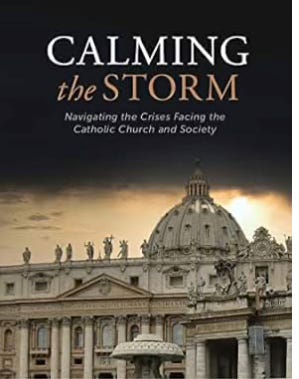
MOJO Academy Book Brief #22 -- Calming the Storm by Father Gerald Murray
Book Title: Calming the Storm: Navigating the Crises Facing the Catholic Church and Society
Author: Father Gerald E. Murray with Diane Montagna
Publishing Year: 2022
Number of Pages: 464
Audible Time: Approximately 12 hours
Brief Summary
Calming the Storm dives into the big issues facing the Catholic Church and society today. In this in-depth interview with journalist Diane Montagna, Father Gerald E. Murray shares his honest thoughts on challenges like the sexual abuse crisis, the breakdown of family structures, and confusion around Church teachings and many many other topics.
Fr. Murray tackles tough topics like the permanence of marriage, receiving Holy Communion, gender ideology, and the role of the Traditional Latin Mass. Through his perspective, readers are encouraged to find strength and peace in the timeless truths of the Catholic Faith while staying true to the Gospel. The book offers a thoughtful mix of addressing today’s struggles and providing hope anchored in Christ's unwavering guidance.
This book has been immensely helpful in my spiritual journey. Fr. Murray writes and speaks with such remarkable clarity that both listening to him and reading his work are truly a joy.
I particularly enjoy the question-and-answer format because it makes the content easy to digest. Unlike traditional chapters that require you to read through to grasp the author’s main point, this format allows you to pause at any time without losing context.
You might know Father Gerald Murray from his appearances on EWTN's Papal Posse. This is his first book, and I really hope he writes more! I highly recommend it—it’s like a great catechism refresher from your friendly parish priest, while also tackling some of the tough questions we face today.
Two Significant Insights
#1—Questioning the Holy Father?
"What role does papolatry have, if any, in enabling the winds of revolution to blow through the Church?
Father Murray: “Papolatry” is a word that, if understood as an analogy to “idolatry,” would be offering false worship to the pope, i.e., elevating the papacy to the level of the divine, in a way that is forbidden because worship can be offered to God alone. In its common usage, though, papolatry generally means treating everything the pope says and does as obligatory for Catholics to both think and do. The Church has never said that, and certainly it’s not coherent with the Scriptures, which tell us that St. Peter was challenged directly by St. Paul regarding arrangements with new converts to the Church. Historically, within the Church, St. Catherine of Siena is honored because she told the pope that he had to leave Avignon, France, and return to Rome, and this was viewed subsequently as a sign of her holiness, that she, in fact, was upholding good order in the life of the Church in the face of political pressures and the like that compelled the pope to be outside of Rome.
It is an unfortunate development from ultramontanism, a nineteenth-century intellectual movement, which was defending the papacy against its enemies, who were basically Enlightenment-inspired revolutionaries who wanted to undermine the authority of the successors of Peter in the Church. In practice, ultramontanism supported centralization efforts of the Church to make the ordinary administration of the Catholic Church throughout the world closely subject to Roman supervision, guidance, and teaching. That is a good thing in itself, but it should never become such that everything the pope says becomes obligatory for Catholics, because that is not what the Church teaches. When papal infallibility was defined by the First Vatican Council, it was made clear that infallibility concerns not everything that the pope says but only those things that are solemnly and clearly defined as being necessary to be believed for salvation.6
If the pope thinks, for instance, that it’s a good idea for the Vatican to issue a stamp with Martin Luther’s image on it, papolatry would say, “Don’t criticize the pope because he’s the pope; he knows what he’s doing.” But Pope Francis himself has encouraged critical writing and thinking about what he does. He’s talked about a spirit of Gospel frankness...
...Reverence for the pope—for his person, teaching, and office—is absolutely necessary. But true reverence is always subject to the reverence we owe to God and the truth. When we are reasonably convinced that the pope is doing something wrong or saying something that is wrong, it is not irreverent to point that out. It may not be welcome, and the pope may reject it, but that doesn’t matter because you’re witnessing to the truth."
My own commentary: Amen!
Let’s take a moment to pause and truly appreciate that incredible lesson.
Thanks be to God!
In the United States, many Catholics have received poor catechesis, often due to overburdened parish priests or insufficiently trained clergy who themselves were formed in poorly managed seminaries. However, the authentic teaching of the Catholic Church is clear: if the pope is in error and there is verifiable evidence to support that claim, it is appropriate to acknowledge it.
This does not mean resorting to personal attacks or making disparaging remarks about the pope. Rather, it means addressing the issue respectfully and truthfully, as the pope is obligated to consider alternative perspectives.
Unfortunately, misunderstandings about the First Vatican Council’s teaching on papal infallibility are common among Catholics. Father Murray provides a clear and accurate explanation of this important doctrine above.
When it comes to criticizing the Holy Father, one should approach it as they would in addressing their own father’s mistakes or missteps—with respect, care, and a desire to guide, rather than condemn. Few would publicly disparage their own parent; instead, they would gently steer them back toward truth and a better understanding of the situation.
This sentiment is echoed in a quote often attributed to Melchior Cano, O.P., a 16th-century Dominican theologian, which serves as a timeless reminder against sycophancy toward the pope:
"Peter has no need of our lies or flattery. Those who blindly and indiscriminately defend every decision of the Supreme Pontiff are the very ones who do most to undermine the authority of the Holy See. They destroy instead of strengthening its foundations."
Cano’s words, drawn from his work De Locis Theologicis (Book 5, Chapter 5), highlight the danger of uncritical support. Such blind allegiance, rather than bolstering the papacy, risks eroding its credibility and authority. His wisdom remains especially relevant in contemporary discussions, reminding us that true loyalty often lies in honest dialogue rather than unquestioning agreement.
#2—A Field Hospital Analogy?
"The greatest proponents of Pope Francis’s pastoral approach, especially of going to the peripheries and his field-hospital analogy, would argue that Francis specifically caters to these kinds of people, for whom the language of traditional Catholic moral teaching fails to resonate. What do you say to this claim?
Father Murray: I do not agree with this approach. It is not the mission of the Church to hide any part of the truth of the Gospel in the vain expectation that people will come closer to God when they are only told the uplifting and inspiring parts of the Gospel and left with the impression that the Church no longer insists on upholding the hard teachings. It causes great confusion when Pope Francis and others indiscriminately accuse those who defend the fullness of Catholic morality of being rigid rigorists whose zeal for God’s law is really a mask hiding emotional problems. That is simply not true in the vast majority of cases. Catholic moral teaching is demanding because God made it so.
My own commentary: How refreshing is that? After practicing the faith fully for over 20 years (a big thank you to my parish and especially the Dominicans for their excellent teaching), I firmly believe that people, especially young people, want to seek and understand the truth about important matters like faith, religion, and Christ’s teachings. They don’t need a watered-down version in the hope that it will make the harder truths easier to accept later. Fr. Murray is absolutely right— the Church should teach the full Gospel of Christ. History has shown us time and time again that when the full truth is taught, conversions happen, and the message of truth and justice truly becomes the "Good News."
Nuggets of Wisdom!
Reading Calming the Storm was a personally enriching experience. Fr. Murray’s calm yet firm approach to addressing divisive topics was both illuminating and encouraging. His emphasis on fidelity to core Catholic teachings inspired me to reflect on how unwavering faith can serve as an anchor of truth in turbulent times. My book is filled with so many nuggets of wisdom that nearly every page is highlighted and covered with notes scribbled in the margins. I even have the Kindle and Audible versions too—can’t get enough!
The book’s call for renewed confidence in the Church’s mission felt particularly hopeful, reminding me of the profound strength found in unity and tradition, even amidst global and institutional upheaval. Just as Christ's words calmed the storm on the Sea of Galilee and brought peace to the apostles, they have the power to bring comfort and calm to our own trials. This book offers profound insights and valuable teachings, reminding us of the enduring relevance of Christ's message. As Fr. Murray highlights in the introduction, Christ's own words from the Gospel of John resonate deeply: "I have said this to you, that in me you may have peace. In the world, you have tribulation; but take heart, I have overcome the world." (John 16:33)
As we await the selection of the 267th successor to the Apostle Peter, let us remember Christ’s words: to be in the world but not of the world. May we remain steadfast in good cheer, always fighting the good fight with faith and courage.
Final Recommendation
Calming the Storm is an indispensable resource for Catholics seeking clarity and guidance through the challenges of modern society and Church crises. It is highly recommended for clergy, theologians, and laypeople committed to deepening their understanding of the Faith. This book serves as an invaluable resource, even for those who are not Christians or Catholics but wish to understand the teachings of the Church.
If You Liked This Book, You Might Like These:
To Light a Fire on the Earth by Bishop Robert Barron – A compelling discussion on proclaiming the Gospel in today’s secular world.
The Next Pope by George Weigel – A thought-provoking exploration of the challenges and opportunities facing the Catholic Church in the modern era.
Life of Christ by Fulton Sheen – A profound exploration of the life and teachings of Jesus Christ.


