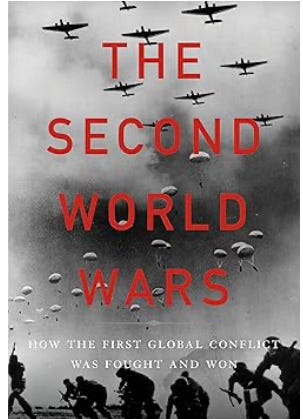
MOJO Academy Book Brief #23 -- The Second World Wars by Victor Davis Hanson
Book Title: The Second World Wars: How the First Global Conflict Was Fought and Won
Author: Victor Davis Hanson
Publishing Year: 2017
Number of Pages: 720
Audible Time: Approximately 23 hours and 15 minutes
Brief Summary
Victor Davis Hanson’s The Second World Wars offers a fascinating analysis of World War II, exploring its causes, conduct, and consequences through thematic lenses rather than a chronological framework. Hanson meticulously examines the war’s economic, technological, and ideological dimensions, showcasing how these factors determined its uniquely global scale and ultimate outcome. Since childhood, I inherited my father’s deep love with all things related to the Second World War—its battles, the soldiers, the Homefront, the leaders, and every detail in between. My father often recounted a vivid memory from when he was just six years old. He stood on the sidewalk in front of his home, watching tanks, trucks, and other military vehicles return from the war in Europe after VE Day. The streets were alive with parades and celebration, a moment of great fanfare that, he said, stayed with him for the rest of his life.
World War II has fascinated me from a young age, so I approached this book with great enthusiasm, especially as a long-time admirer of Victor Davis Hanson’s previous works. And he did not disappoint!
Departing from conventional military histories, the book underscores the extraordinary material and industrial advantages possessed by the Allied forces. Hanson also highlights the contrasting political systems, leadership styles, and cultural ideologies that shaped each participant’s wartime strategies. Hanson paints World War II as a “war of resources,” offering a fresh and thought-provoking take that sheds new light on one of history’s most important conflicts.
we the living post WWII have lived in a vastly different world than the pre WWII world. This war was unlike anything the world had ever witnessed. A fact often overlooked by those who study it superficially is that, by 1945, only eleven countries in the entire world remained neutral. Hanson highlights another striking fact: civilians accounted for an overwhelming 70 to 80% of the total casualties. A truly heartbreaking statistic.
At first glance, the size of this book—or audio version, if you prefer, as I do—might seem intimidating. However, I urge you to give it a chance. You'll find it richly rewarding, like sitting in the classroom of the best high school history teacher or college professor you’ve ever had, guiding you through the complexities of WWII with an engaging and insightful narrative that’s nearly impossible to put down. Yes, it really is that impressive.
Two Significant Insights
#1—Breakdown in Diplomacy, & Even A Greater Failure in Deterrence.
"World War II, however, began traditionally enough in 1939–1940 in Europe as a series of border conflicts exclusively between European powers, including Britain. As is true of much of European history, aggressive states attacked their perceived weaker neighbors, usually through surprise and in reliance on greater preparation and armament. By the end of 1940, what had so far seemed to be familiar European infighting had achieved a Caesarian or Napoleonic scale. But by the end of 1941, something quite cataclysmic followed: all the smaller conflicts compounded unexpectedly into a total, global war, in which the Axis powers of Germany, Italy, and Japan were soon materially outmatched, strategically unprepared, and likely to lose in catastrophic fashion. Advances in Western technology and industrialization, when married with both totalitarian zealotry and fully mobilized democratic states, also ensured that the expanded war would become lethal in a way never before seen.
Three unexpected events explain why the border fights that had begun periodically—and sometimes ended and started again—between 1939 and 1941 were no longer seen as a series of separate wars but had coalesced and became redefined as part of what we now know as World War II in the United States, or as the Second World War in the Anglosphere. First, Germany without warning invaded its partner, the Soviet Union (June 22, 1941). Second, in addition to its long war with China, Japan took on new enemies by conducting surprise attacks on the Pacific and Asian bases of Great Britain and the United States (December 7–8, 1941). Third, both Germany and Italy then declared war against the Americans (December 11, 1941).
Only these unforeseen developments in the single year of 1941 recalibrated prior regional conflicts in Europe and Asia into a continuous and now interconnected global war that drew three new powerful participants—Japan, the Soviet Union, and the United States—into the two formidable alliances, with a vast array of aircraft carriers, sophisticated planes, artillery pieces, and vehicles. The new worldwide fight was rebranded as one of Germany, Italy, and Japan against Britain, the Soviet Union, the United States, and China—with smaller and weaker allied states on both sides. Thus the holistic idea of a Second World War was born."
Hanson vividly illustrates how localized tensions escalated into a global conflict that forever altered international relations. He highlights the catastrophic failure of diplomacy and more importantly deterrence, describing it as one of the greatest missteps in human history, particularly since World War II was, in many ways, preventable. Elsewhere, Hanson brings us this hard fact, “The tragedy of World War II—a preventable conflict—was that sixty million people had perished to confirm that the United States, the Soviet Union, and Great Britain were far stronger than the fascist powers of Germany, Japan, and Italy after all—a fact that should have been self-evident and in no need of such a bloody laboratory, if not for prior British appeasement, American isolationism, and Russian collaboration.”
#2—In England, the Luftwaffe Finally Met a Serious Enemy
"The point is not that in brief encounters British Spitfire pilots proved consistently superior either over Dunkirk or the Channel to their German Bf 109 counterparts. Instead, the lesson is that the Luftwaffe finally met a serious enemy. And this new experience demonstrated that German air power—Stuka dive bombers, fleets of medium and often unescorted bombers, adequate pilot training programs, moderate aircraft production, first-generation radar, ground-breaking use of radio navigation and pathfinder units—was no longer exceptional. And yet it had to be extraordinary to fulfill Hitler’s agendas on the relative cheap. Fortunately for the Germans, the Royal Air Force over France continued to conduct unescorted bomber attacks against German ground deployments, at one point losing two hundred bombers in three days.
Churchill, in a controversial but ultimately wise decision, at last chose not to reinforce the RAF’s fighter fleet over a sinking France. About a third to a half of the RAF deployable fighters and over two hundred pilots and planes had already been lost in May and early June. The long-expected full showdown between the two air forces would come a few weeks later in mid-summer 1940."
Hanson once again delivers exceptional analysis, showcasing his expertise as a military classicist. His training is evident throughout the book, adding both depth and insight to his work. One of the highlights of this book lies in the small, thought-provoking details, like the quote: "Churchill, in a controversial but ultimately wise decision." This brief comment sparks curiosity, encouraging readers to delve deeper into the context behind such decisions.
It invites questions like: Who advised Churchill, or did he make this decision independently? What information was available to him at the time? How did he ensure the decision was effectively implemented? And was there any resistance from key figures, perhaps within the upper ranks of British fighter command? These moments encourage further exploration, making the book a gateway to richer understanding. Like an exceptional museum guide leading you through magnificent corridors, pointing out treasures with a gentle reminder: "This is worth your time, but we don’t have enough of it today. Come back when you can truly immerse yourself and uncover this hidden gem of wisdom." Hanson in this book is such a guide.
Nuggets of Wisdom!
Reading The Second World Wars was a captivating experience. Hanson’s ability to synthesize such vast amounts of information into clear themes offered fresh perspectives on a well-covered historical period. I was especially struck by his exploration of the Allied powers’ resource management and how crucial it was to sustaining the war effort. It also provided thought-provoking insights into how leadership and cultural values shaped everyone’s approach to the conflict.
Hanson’s thematic approach (Ideas, Air, Water, Earth, Fire, People and Ends) reminded me of how even the most familiar historical events can be seen anew when examined from a different angle. His work serves as a powerful reminder of the importance of preparation, leadership, resilience, and strategy in overcoming adversity. This book is filled with countless nuggets of wisdom and will hold a permanent, prominent place on my bookshelf. It will serve as a trusted resource I can turn to for guidance throughout my life.
Final Recommendation
The Second World Wars is a must-read for history buffs, military enthusiasts, and anyone seeking a deeper understanding of World War II beyond conventional timelines. Hanson’s engaging, thematic approach will appeal to both casual readers and academic audiences looking for an analysis with fresh perspectives. If you're looking to deepen your understanding of the Second World War, this is an essential and must read. I highly recommend.
If You Liked This Book, You Might Like These:
The Savior Generals by Victor Davis Hanson – An insightful exploration of leaders who turned the tide in history's critical battles.
The Liberation Trilogy by Rick Atkinson – A detailed and gripping account of the Allied forces in Europe during World War II, covering the North African campaign, the invasion of Italy, and the liberation of Western Europe. Three incredible books featuring insightful storytelling by one of the most acclaimed historians of our time. Truly a remarkable read! They’re also available on Audible if you prefer to listen and cheat.
Freedom’s Forge by Arthur Herman – A compelling account of how American industry helped win World War II. Also on Audible!


