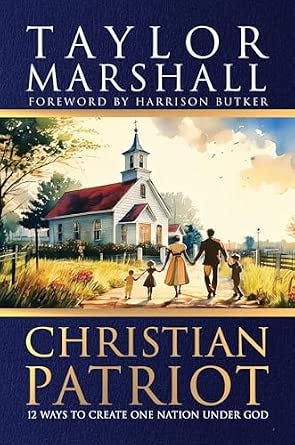
MOJO Academy Book Brief #32 -- Christian Patriot by Taylor Marshall
Book Title: Christian Patriot: 12 Ways to Create One Nation Under God
Author: Taylor Marshall
Publishing Year: September 2025
Number of Pages: 248
Audible Time: Approximately 7 hours. Pretty easy to crush this one as I did. :)
Brief Summary
We just celebrated our 250th birthday as a nation. Now, in the wake of that milestone, feels like exactly the right moment to revisit a book Taylor Marshall published in 2025 and (I read last year), one that asks the one question that actually matters: what do we do with this country now, and how do we love her rightly? Christian Patriot: 12 Ways to Create One Nation Under God is Marshall’s answer, and it is a pretty good one.
Marshall makes a case that Western Civilization is not really a geographic or cultural label at all. It’s a euphemism. What we actually mean when we say “Western Civilization” is Christian Civilization. Strip out the Christian foundation — natural law, the dignity of the person, the ordered loves that build a family and then a nation — and there is no “West” left to defend. There’s just a shell.
But the real contribution of this book, the reason you need to read it, is the sharp line Marshall draws between two words a lot of the MAGA world has been using interchangeably lately: patriotism and nationalism. He argues they are not the same thing. They are not even close. One is a virtue. The other is a distortion of a virtue. Get that distinction wrong, and you will get a lot else wrong with it.
I’ll tell you now — I don’t agree with everything in this book. Marshall spends real energy making a case for Christian or Catholic monarchy or what he is calling “Christianized Constitutionalism,” and I think he’s simply wrong there. But more on that in a moment. That disagreement doesn’t erase the value of this book. It actually sharpens it and helped me to sharpen my own thinking.
Two Important Quotes
1. “The cultural ethos of Christianity and Natural Law is under attack and taking a beating. Some have concluded that we are living in a ‘post-Christian’ society, but the book in your hands rejects that label. We are not ‘post-Christian’ because we have not lost the culture war…yet. This book is a declaration that ‘Western Civilization’ is merely a modern euphemism for ‘Christian Civilization,’ and that Christian Patriots must defend, sustain, and extend the reign of Jesus Christ in their hearts, in their families, and within the political arena. This current culture war for Christian civilization (let us stop referring to it as ‘Western civilization’) is more consequential than the First and Second World Wars combined. Sadly, Christians are currently losing this war, but this is only temporary. ‘But in all these things we overcome, because of him that hath loved us’ (Romans 8:37). Our Lord Jesus Christ conquered sin, death, and hell. Christ sits victorious on his throne and has already declared: ‘I make all things new’ (Revelation 21:5). The key to this renewal of all things in Christ lies in the prayer he taught us: ‘Thy Kingdom come, Thy will be done, on earth as it is in Heaven’ (Matthew 6:10). His grace is sufficient and effective for us, but we must pray for it and live for it—not only for the sake of His kingdom, but also for the salvation and well-being of our children and our children’s children. If we are currently losing the culture war, we must begin with an honest self-reflection of why we are losing. What deficiencies in our Christian worldview allowed this to occur? What compromises did we make in the 1950s?”
Did you catch that? He calls this culture war more consequential than the First and Second World Wars combined. Let that sink in. Not a metaphor. Not hyperbole for effect.
He means it, and honestly, when you consider that the two World Wars were fights over territory and tyrants while this fight is over the soul of the civilization itself, he might—actually—be right.
Marshall refuses to let us hide behind the phrase “post-Christian,” because that phrase lets us off the hook. It says the war is over. He says it isn’t. We haven’t lost yet, and losing was never inevitable in the first place. I disagree with that premise too, but let’s get through the book brief without me being so disagreeable, shall we?! lol
onto quote #2
2. “From a Christian perspective, patriotism takes precedence over nationalism because it aligns more closely with the virtues of charity and justice. Nationalism is absent in theological content, while patriotism boasts a rich tradition. As Saint Thomas Aquinas describes it, patriotism falls under the virtue of piety, a natural extension of honoring one’s parents as outlined in the Ten Commandments. It represents a love for the familiar—father, land, beliefs, and family—aimed at promoting the common good for all. Nationalism, however, often transitions from love to a form of natus-birth supremacy, prioritizing nativism. Thomas Aquinas conceptualizes patriotism as a virtue within the ordo amoris (order of love), which reflects a hierarchy of loves: God first, then parents, family, neighbors, and finally, fatherland.”
Here comes our most important nugget. Patriotism is a virtue. Nationalism is not. Patriotism is a virtue. Nationalism is not.
Marshall roots this in Aquinas and the ordo amoris — the order of love. God first. Then parents. Then family. Then neighbor. Then fatherland. That’s the hierarchy, and every love in that chain stays healthy only when it stays in its proper order.
Nationalism breaks the chain. It takes love of country and tries to promote it above the loves that are supposed to come before it — sometimes even above God. That’s not patriotism anymore. That’s idolatry wearing a flag pin.
My Nuggets of Wisdom!
Marshall treats Christian nationalism as a power-centric project — an attempt to capture the state in the name of Christianity. Christian patriotism, on the other hand, is virtue-centric. It’s Christians loving, reforming, and sacrificing for their nation under Christ the King, starting with family and local culture, not with seizing the levers of the state.
That’s the whole ballgame right there.
Christian Nationalism: power-centric, state-capture, love of country risks outranking love of God
Christian Patriotism: virtue-centric, begins at home and in local culture, ordered under Christ the King
I think Marshall is onto something here, and I think he’s doing it wisely. Donald Trump is unlike most other presidents in our history. You have to go back to men like Andrew Jackson, Teddy Roosevelt, and FDR to find the real comparison — presidents who took the energy out of the room and forced you to pay attention to them.
That doesn’t mean they were great.
It means they were bigger than life. It’s part of our U.S. history.
People either hated those men with real venom or loved them with an excess that bordered on worship, and there was no comfortable middle ground with any of them.
Trump is cut from that same cloth. Marshall, in my opinion, is trying to shape the post-MAGA conservative world with this book, getting ahead of the question of what comes next before someone else answers it for us, and there’s a real temptation in some corners to reach for “Christian Nationalism” as that answer.
Marshall is standing up and saying — not so fast. Words matter. Categories matter. Get the category wrong and you’ll build the wrong thing.
Now, I do need to be honest with you about where I part ways with him, because an honest review is the only kind worth giving.
Marshall makes the case, at points in this book, that Christian or Catholic monarchy is preferable and what he might call a “Christianized Constitutionalism” — the American system of ordered, constitutional self-government. I know some of you just felt your eyebrows go up. Mine did too the first time I hit that section.
Here’s my honest reckoning with it.
Marshall isn’t wrong that a monarchy explicitly ordered under Christ has real historical and theological pedigree — Aquinas himself wrote favorably of just kingship. I’ll grant him that much.
But I think he undersells what our U.S. constitutional system actually is at its best: a Christianized ordering of self-government, built by men who understood natural law every bit as seriously as any monarch’s court theologian did.
Lincoln understood this.
Lincoln was a devoted student of natural law, and our founding documents are soaked in it. You don’t need a throne to have a nation ordered rightly under God. You need citizens who understand the ordo amoris in their own hearts, and a system built to protect their freedom to live it out.
That, to me, is the stronger argument — and ironically, it’s Marshall’s own patriotism-versus-nationalism framework that helps make the case against his monarchy argument. Sorry Taylor.
Teaching better civics and pursuing the virtuous life, in my humble opinion, is what actually restores a country to better self-government — not a throne.
BUT, but, don’t let that one disagreement scare you off the book.
Marshall is a good author, and this is a good book, even where I don’t agree with every conclusion. That’s what mature reading looks like — you wrestle with a serious thinker, you keep what’s true, and you argue back where it’s warranted.
Final Recommendation
This book is for every conservative and every Christian trying to figure out what to call themselves right now, in this soon to be post-MAGA, post-250th-anniversary moment.
If you’ve found yourself reaching for the label “Christian Nationalist” without fully knowing what you meant by it, this book is for you. If you’ve felt the pull toward the state-capture instinct and wondered whether that’s really what love of country requires — this book will set you straight.
Patriotism is a virtue. Thats important. It always has been. Nationalism is not, and it never was.
Get that right, and a great deal else falls into place — your family first, then your local community, then your nation, all of it ordered under Christ the King rather than reversed and disordered.
Read the book. Wrestle with it. Argue with the parts you disagree with, the way I did with the monarchy question. That’s not a failure of the book — that’s exactly what a serious book is supposed to produce in a serious reader.
If You Liked This Book, You Might Like These
Liberty and Tyranny by Mark Levin – the great one Mark Levin makes the constitutional and founding-principles case that pairs perfectly with Marshall’s virtue-centric patriotism; read them back to back and you’ll see how ordered liberty and ordered love point to the same conclusion.
The Case for America by Bret Baier – Baier’s defense of the American founding stands as a real-world answer to Marshall’s monarchy argument, showing what a nation ordered under natural law and self-government looks like in practice.
Another Sort of Learning by Fr. James V. Schall, S.J. – Schall’s classical and Catholic framework for education is the perfect companion piece, since Marshall’s whole argument depends on Christians actually being formed in virtue before they can practice patriotism rightly.
Keep fighting the good fight and building the flourishing life!


