MOJO Academy Book Brief #34--The Trump Economic Miracle
MOJO Academy Book Brief --The Trump Economic Miracle
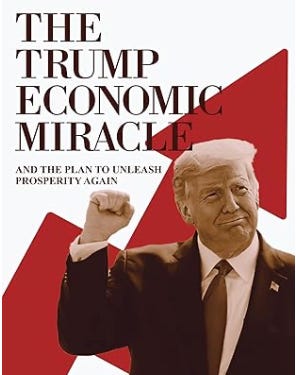
Book Title: The Trump Economic Miracle
Authors: Stephen Moore and Art Laffer
Publishing Year: 2024
Number of Pages: 176
Audible Time: no audible version...BOOOOO!!!
Brief Summary
The Trump Economic Miracle by Stephen Moore and Art Laffer takes you behind the scenes of the Trump administration’s 2016 economic policies and how they played out. The authors, who were key advisors in shaping those 2016 policies from Trump's first term, break down the big moves—like tax cuts, deregulation, and trade deals—that they say led to massive job growth, a booming stock market, and a comeback for industries like manufacturing. They’re big believers in free-market economics (supply-side economics to be exact) and this book helps explain why those strategies worked in the past and why they will work in the future. Most especially in 2025. If you're curious about the thinking behind the economic decisions of Trumps first term and you would like an economic blueprint for Trump's second term, this book offers a firsthand look and will provide you with great insight. On MOJO Minute #385, we dive deeper into this book—definitely give it a listen!
Two Important Quotes
#1--The Donald in 1999
"As with most things, President Reagan had it right. But Reagan echoing the economic thoughts of President John F. Kennedy , who had already said, in 1962, and I quote, "The paradoxical truth is that the tax rates are too high today and tax revenues are too low, and the soundest way to raise revenues in the long run is to cut rates now..."
"Reagan and Kennedy's views [on cutting taxes] prove that smart tax policy shouldn't be a partisan issue. It should be common sense. If you tax something you get less of it. It's as simple as that."
#2--What were the results?
"More than six years have gone by so let's fast forward to today and examine how the tax plan worked. For five years the Democrats have berated the plan as a giant tax cut for the rich with no economic benefits. What does the actual evidence show?
Right out the gate, the Trump tax cut awakened the American economy to its potential as if he had twisted the ignition switch on a Ferrari.
Trump's policies in just the first year restructured the American economy. As our colleague Larry Kudlow put it, "we've moved from secular stagnation, (i.e. high taxes, massive regulation, huge government spending and a distain for business and investors) to a new private-sector incentive system that rewards success"
The keys to success were slashing individual and corporate tax rates, providing 100% immediate expensing for plants and technology and making it easy for big companies who fled our high-tax system to bring the money back home. The war against business and investment ended overnight.
When we would see President Trump after the tax bill passed, and he asked us whether it was working we were to respond, "even better than we expected." And he would reply, "Not better than I expected." He was a true believer.
And just the first 18 months after the tax bill became law, more than 250 American companies announced gigantic investment projects (Apple's projects were valued at $350 billion), paid sizable bonuses to their workforces, increased 401(k) contributions, and raised corporate minimum wages and other benefits.
The stock market rally was shot out of a cannon with $7 trillion in new wealth. All the critics could say was that the gains went to shareholders through stock buybacks. They didn't seem to understand that some 150 million Americans directly or through worker pension plans own stock.
Democrats then claimed that only crumbs were left for workers. But after the tax cut, Walmart -which has bitterly fought attempts to raise federal minimum wage raised its internal minimum wage for virtually all of its wage employees, gave bonuses of up to $1000, expanded maternity and parental leave, and committed $5,000 to every employee who adopts a child.
(and it could go on and on and on. Chapter 3 of this book is very, very detailed.)
My Nuggets of Wisdom!
I’ve always been a fan of supply-side economics, but this book really brought it to life for me. It’s full of common sense, great stories from economic history, and solid facts. I’ve read other books by these authors (all good!), but this one does an amazing job explaining their theories and tying them to real historical events—stuff I can really get into. And let’s be real, the Trump economy took off. Most people saw that plain as day by November 2024, no book needed. But if you’re curious about the “why” behind how these policies work in the real world, this book is a great place to start.
For a double dose of supply-side economics, I’d also recommend taking Hillsdale’s free course on the topic. It’s taught by Art Laffer, one of the co-authors of this book, and pairs perfectly with what you’ll learn here. Definitely worth checking out! This book and that course are absolute nuggets of economic wisdom!
I’ll be honest—I didn’t vote for Donald Trump in 2016. I caught a lot of flak for it, too, from friends, colleagues, and even some people at church. At the time, I just didn’t think Trump had any real principles driving his policies. I had a feeling he’d take over the Republican Party, and people like me would be left looking for a new place to call home.
I didn’t realize until 2018, after the tax cut passed in late 2017, that both of these authors, along with Larry Kudlow, had worked on the economic package—and that it was packed with supply-side economic policies. I was blown away!! Truly! The more I looked into it, the more I realized this was better than any previous GOP president’s economic plans. This was the real deal—pure, authentic supply-side economics with nothing watered down.
A huge shoutout to Senate Finance Chairman Orrin Hatch--who at the time-- did much of the heavy lifting to keep the package intact. May he rest in peace! Keeping a legislative package together, especially an economic proposal for a Republican president, is no easy task. Managing over 20 GOP members in one room trying to find a compromise? That’s a whole other level of herding cats. Lol. (reference Reagan's 1982 economic package in Steven Hayward’s fantastic biography, The Age of Reagan: 1981 to 1989—it was quite the political circus!)
Final Recommendation
This is a must-read for anyone curious about economics, public policy, or how supply-side economics actually works. It dives into how Trump’s economic package played out in 2017 and what the game plan might look like in 2025. If you're a conservative, libertarian, or even a populist like many of Trump’s fans, and you want to get a better grasp on supply-side economics, this book is super easy to read and makes it all really simple to understand! I’d suggest Democrats give this book a read too, but honestly, with so many extreme views out there, I’m not sure how many would be interested in economic growth without tying it to redistribution authoritariuan policies.
Whether you agree with Moore and Laffer’s perspective or not, their take really makes you think about the economic policies that shape our daily lives. It’s a great read for econ students, policymakers, business leaders, or anyone trying to figure out what drives economic success. You know what we really need? Consistent economic growth above 3% of GDP each year to get ourselves out of this mess. Only supply-side economics can deliver the kind of sustained growth we’re talking about. I totally recommend this book!
If You Liked This Book, You Might Like These
The JFK Revolution by Larry Kudlow - This book explores how President John F. Kennedy’s economic policies fueled major growth and prosperity. Kudlow explains JFK’s bold tax cuts and supply-side reforms, showing how they transformed America’s economy. He ties history to today, arguing that JFK’s ideas still offer lessons for modern policymakers. With sharp insights and engaging analysis, it’s a must-read for history buffs, economics fans, or anyone interested in the intersection of politics and innovation. I loved, loved, loved this book!
Capitalism and Freedom by Milton Friedman – A timeless look at how economic freedom ties into personal liberty, written by one of the most renowned economists ever. This is a modern day classic for anyone wanting to understand free market capitalism.
Taxes Have Consequences by Arthur Laffer, Brian Domitrovic, and Jeanne Sinquefield – This is a fascinating deep dive into how tax policies affect economic growth and social prosperity. It makes a strong case that lower taxes can spark innovation, boost entrepreneurship, and create jobs. Packed with solid research and relatable examples, it challenges the usual way we think about taxes and encourages us to rethink their role in shaping the future, leaning into supply-side economic ideas. This book isn’t for the faint of heart, but hey, it’s on Audible—so there’s that! Hooyah!


