MOJO Academy Book Brief--Day 22--Empire of Liberty
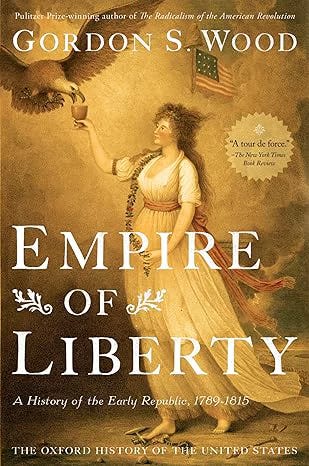
Book Title: Empire of Liberty: A History of the Early Republic, 1789–1815
Author: Gordon S. Wood
Publishing Year: 2009
Number of Pages: 778
Audible Time: Approximately 31 hours
Brief Summary
Most Americans think the story of our country goes like this: we fought the Revolution, we won, George Washington became president, and then everything worked itself out. Easy peasy. No big deal. No, no. That is not how it went. Not even close.
Gordon S. Wood — Alva O. Way Professor of History Emeritus at Brown University, winner of the Pulitzer Prize and the Bancroft Prize, and arguably the greatest living historian of the American founding era — takes nearly 800 pages to prove it. His credentials speak for themselves:
Pulitzer Prize winner for The Radicalism of the American Revolution
Bancroft Prize winner — the highest honor in American historical scholarship
Professor Emeritus at Brown University, where he taught for decades
Author of the definitive scholarly works on the founding generation
Empire of Liberty covers the first 26 years of our republic under the Constitution, from Washington’s inauguration in April 1789 to the close of the War of 1812. What Wood reveals is a nation teetering on the edge. The men who built this country — Washington, Hamilton, Jefferson, Madison, Adams, John Marshall — were brilliant, passionate, often reckless, and frequently at each other’s throats.
They hated political parties. They built political parties. They wanted liberty. They couldn’t agree on what liberty meant. The Federalists, led by the towering genius of Alexander Hamilton and the fierce independence of John Adams, wanted a muscular centralized government, a national bank, and a fiscal-military state capable of competing with Britain and France. The Jeffersonian Republicans wanted the exact opposite — a small government, a nation of free yeoman farmers, and a world without standing armies or crushing debt. The clash between these two visions was not just political. It was a clash of souls. It was a battle over the very identity of America. That is worth sitting with for a moment.
What makes this book extraordinary — and I want to be honest with you, this is a heavy, heavy lift on Audible at 31 hours — is the sheer sweep of it. Wood doesn’t just give you the great men. He gives you the whole society:
The evangelical religious revivals reshaping the spiritual life of the country
The westward expansion cracking open the continent
The brawling congressmen literally caning each other in the Capitol (yes, this was before the famous caning in the lead up to the Civil War — research the Griswold attack on Lyon of 1798 — fascinating stuff)
The rise of John Marshall and the Supreme Court’s audacious claim of judicial review
And always, always, the unresolved question of slavery lurking beneath every achievement
Wood sees it all, names it all, and writes it all with a grace that is frankly majestic.
A fair warning: Wood leans Jeffersonian. He has more sympathy for the Democratic-Republicans than for the Federalists, and it occasionally shows. As a conservative, I will point out that Hamilton’s vision — the strong national government, the financial system, the industrial power — is ultimately what made America the greatest economic force in human history. Wood undervalues that. But that disagreement doesn’t diminish his scholarship. Not one bit. This book is a masterwork, and you need it on your shelf.
Two Important Quotes
1. “America was unique, declared Republican Nathaniel Cogswell in 1808. It ‘possesses all the excellencies of the ancient and modern Republics, without their faults.’ ‘It possesses, if I may so express myself, the seeds of eternal duration.’ America, said recent Harvard graduate Pliny Merrick in 1817, would never suffer the fate of Greece and Rome. Its political institutions were ‘susceptible of infinite improvement’; they ‘will endure unhurt by the ravages of time, and . . . future ages will be their witness, that decay’s effacing fingers are too feeble to crush their massive columns!’”
The seeds of eternal duration. Stop and let that phrase settle. That is what the men and women of the early republic believed they had built — not just a nation, not just a government, but something new under the sun. Something that could actually last.
Now — you might say, well of course they believed that, everyone believes that about their own country at the founding. But here is what Wood reveals that is so striking: this confidence was earned. It was forged in the crucible of those first 26 years, after every crisis, every constitutional near-death experience, every war and economic collapse and political betrayal. And they still believed.
“Decay’s effacing fingers are too feeble to crush their massive columns.” Oh, that is so good. So good. Are we living up to that faith today? We had better be.
2. “From the 1790s through 1815 it was the Republicans alone who celebrated the Declaration of Independence and toasted as its author their leader, whom Joel Barlow called ‘the immortal Jefferson.’ The Republicans honored the Declaration, however, not for its promotion of individual rights and equality, as would be the case for all political parties after 1815, but for its denunciation of the British monarchy and its assertion that the new nation had assumed a ‘separate and equal Station . . . among the Powers of the Earth’ — something the Republicans thought the Anglophilic Federalists were reluctant to acknowledge. Indeed, as late as 1823 Jefferson was still fulminating over the way the Federalists treated the Declaration, seeing it, he said, ‘as being a libel on the government of England . . . [that] should now be buried in utter oblivion to spare the feelings of our English friends and Angloman fellow citizens.’”
You see, this is Wood at his absolute best — showing you something about the founding that completely upends what you thought you knew. We celebrate the Declaration of Independence today as a universal statement of human rights. “All men are created equal.” Self-evident truths. The dignity of every human person. And that is right and true and beautiful.
But Wood reveals that in the earliest decades of the republic, the Declaration was contested ground. The Federalists were embarrassed by it. The Jeffersonians weaponized it for partisan purposes. It took a generation — and ultimately a Civil War — before the Declaration became what Lincoln made it: the moral north star of the entire American experiment.
That is worth knowing. That is sobering and glorious all at once.
My Nuggets of Wisdom!
I will be honest with you — this is not a book you crush in a week on Audible. At 31 hours, Empire of Liberty is a serious commitment. I listened to it in stages, the way you eat a great feast — not all at once, but returning to it again and again, letting it digest. And it was worth every single hour.
What struck me most is how fragile everything was. We look back at the founding with this golden haze — these demigods in powdered wigs, calmly and brilliantly constructing the greatest nation in history. Not even close. These were men under enormous pressure, making desperate gambles, losing their tempers, betraying each other, and often getting it badly wrong.
Wood walks you through the crises one by one, and each one is more alarming than the last:
The Alien and Sedition Acts of 1798–1799 — John Adams’ administration nearly criminalized political opposition. A near-death experience for American liberty. A sobering, deeply unsettling chapter that most Americans have never heard of.
The Revolution of 1800 — the peaceful transfer of power from the Federalists to the Jeffersonian Republicans. Not inevitable. A miracle. For the first time in human history, a political party surrendered power to its sworn enemies because the people had voted. Every republic before America had ended in a strongman, a coup, or a collapse. Not this one. The system held.
The War of 1812 — a second war with Britain that nearly tore the young republic apart, exposed the weakness of the federal government, and ended, somehow, with America still standing.
Here comes our most important nugget: America’s confidence in itself had to be built. It was not given. Read that first quote again. “The seeds of eternal duration.” Nathaniel Cogswell said that in 1808 — after fifteen years of political warfare, constitutional crises, foreign threats, and economic chaos. Pliny Merrick said it in 1817 — after the War of 1812 nearly destroyed the young republic.
These were not naive men. They were men who had seen the worst and still believed. That kind of confidence — earned confidence, tested confidence, confidence that has survived the fire — is exactly what we need to reclaim today. We have the same seeds. We have the same founding documents, the same constitutional framework, the same bedrock principles. The question is whether we have the same faith.
Here is what Wood’s second quote drove home for me in a way I did not expect. I have read about the Declaration of Independence my entire life. I have celebrated it every July 4th. I thought I understood it. But Wood shows that even the founders themselves could not agree on what it meant or what it was for. The Federalists wanted to bury it. The Jeffersonians turned it into a campaign slogan. It wasn’t until Abraham Lincoln — in the crucible of the Civil War — that the Declaration’s moral core became the beating heart of the entire American project.
Lincoln deliberately reached back past the Constitution, past the compromises of the founders, all the way to 1776, to argue that the promise of equality was there from the very beginning. It is worth noting that Lincoln delivered the Gettysburg Address in November 1863 — just 87 years after the Declaration was signed. In fewer than 275 words, he redefined what America was for. We have been living inside that redefinition ever since.
Final Recommendation
This book is for the serious patriot. This is not a casual beach read. If you are a history buff who wants to go deep, if you believe that understanding the founding is essential to understanding what we are fighting for today, if you are a student of liberty who wants to know not just what the founders built but how close they came to losing it — this is your book.
I will say plainly: if you only have 10 or 15 hours to spend on this era, start with David O. Stewart’s The Summer of 1787 or Wilford McClay’s Land of Hope. But if you want the full, sweeping, magisterial account — the culmination of a lifetime of brilliant thinking and writing by one of America’s greatest historians — then Gordon Wood’s Empire of Liberty is the book. It is Volume IV in the Oxford History of the United States, widely considered the gold standard of American historical scholarship.
We live in a moment when people are tearing down statues of the founders, rewriting their legacy, and teaching our children that this country was built on nothing but oppression. Wood doesn’t sugarcoat the founders’ failures — especially on slavery. But he also shows you what they built, what it cost, and why it mattered. He shows you men and women who, after every catastrophe, still believed that America possessed “the seeds of eternal duration.”
That is the honest, full-throated telling of our history that we need right now. Today. Not six months from now. This moment.
Keep fighting the good fight.
If You Liked This Book, You Might Like These
The Summer of 1787 by David O. Stewart – A vivid, on-the-ground account of the Constitutional Convention itself; where Wood gives you the full arc of the early republic, Stewart drops you into that Philadelphia statehouse for three months and twenty-four days and never lets you leave.
Land of Hope: An Invitation to the Great American Story by Wilford McClay – The finest single-volume American history written in the last generation; McClay gets the moral and spiritual framework of America exactly right, and pairs with Wood by giving you the north star that Wood’s Jeffersonian sympathies sometimes obscure.
The Federalist Papers by Alexander Hamilton, James Madison, and John Jay – If Wood’s account of the Hamilton-Jefferson battle fires you up, go straight to the source; these 85 essays, written in real time during the fight over ratification, are the deepest, most brilliant defense of the Constitution ever written, and they are as urgent today as they were in 1788.


