MOJO Book Academy Book Brief #31
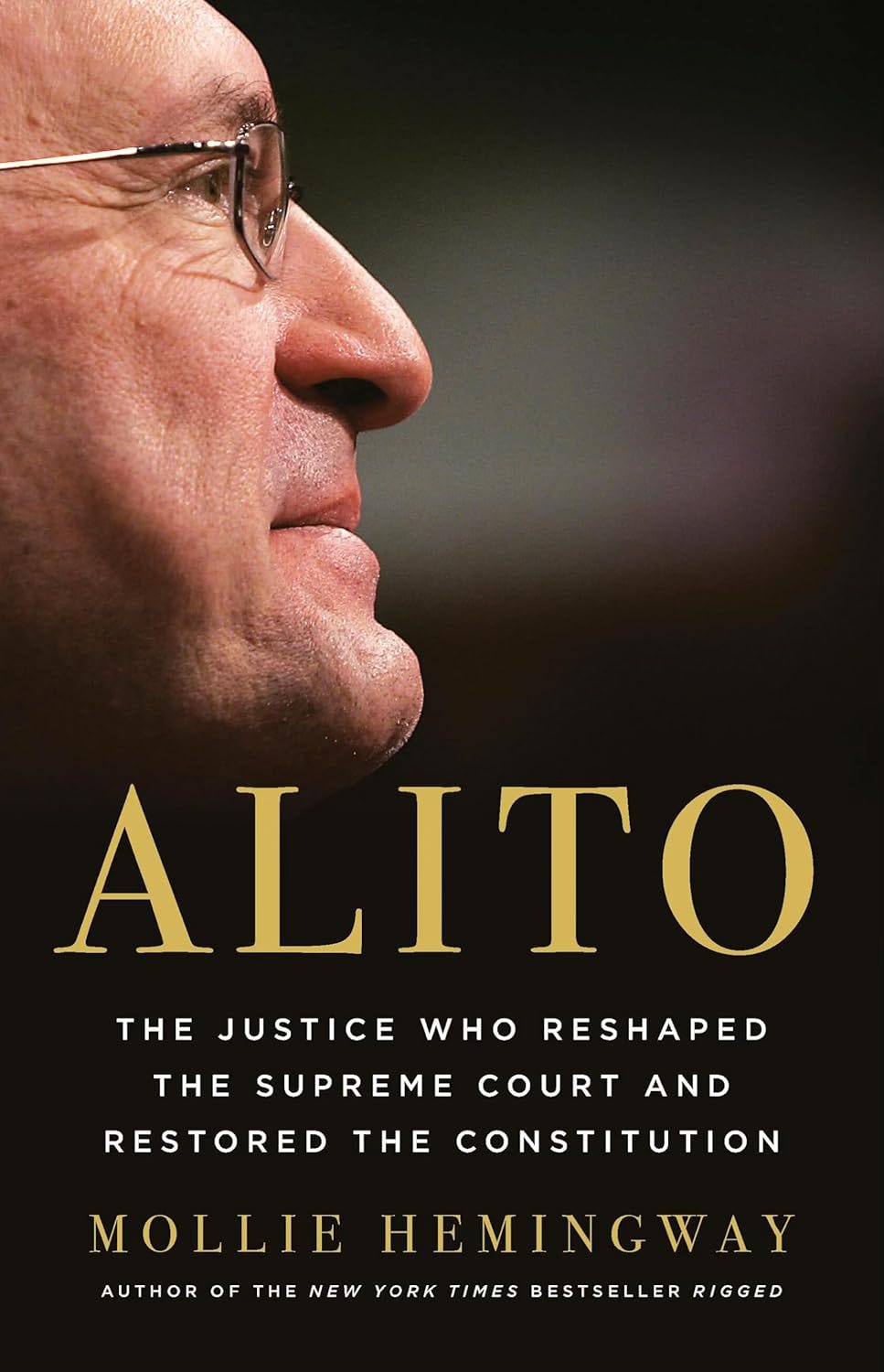
Book Title: Alito: The Justice Who Reshaped the Supreme Court and Restored the Constitution
Author: Mollie Hemingway
Publishing Year: April 2026
Number of Pages: 352
Audible Time: Approximately 10 hours 23 minutes
Brief Summary
For fifty years, conservatives have prayed and worked for a counterrevolution in the legal profession. Mollie Hemingway’s Alito makes the case that it is finally here, and Samuel Alito has been one of its quiet architects. This is not just a biography. It is a chronicle of how one justice’s patient, fact-driven jurisprudence helped dismantle decades of judicial activism.
Most conservatives, myself included, default to Clarence Thomas as the celebrity justice of the modern Supreme Court. Hemingway makes a compelling case that Alito belongs right alongside him. His opinions on Roe, on Chevron deference, on religious liberty, are not isolated wins. They are chapters in a sustained legal revolution decades in the making.
You see, Hemingway doesn’t just tally the victories. She traces the formation of the man, from his clerkship under Judge Leonard Garth to his rise on the Third Circuit to his confirmation battles, showing how a single judicial philosophy, rooted in facts and text rather than abstraction, built over a lifetime into something the whole country now feels the weight of.
Two Important Quotes
1. “With President Trump’s appointees in place, the conservative judicial movement achieved a string of momentous victories at the Supreme Court. Leading the list was the overruling in 2022 of Roe v. Wade, the ‘egregiously erroneous’ decision that had once seemed maddeningly invulnerable to correction. In 2023, the Court ruled against institutionalized racial bias in colleges and universities. In 2024, it ended ‘Chevron deference,’ the doctrine that had given unchecked authority to federal bureaucrats to impose rules and regulations. In 2025, it ruled that the religious rights of parents were violated by public schools that forced radical gender ideology on young children.”
Did you catch that? Four years, four landmark rulings, each one chipping away at a different pillar of the administrative and judicial left. Roe gone. Race-based admissions gone. Chevron deference, the doctrine that let unelected bureaucrats write law from behind a desk, gone. And parental rights over their own children’s education, finally defended. That’s not a string of lucky breaks. That’s a revolution, executed methodically, one case at a time.
2. “Looking closer, one notices a photo of Alito with Leonard Garth, the longtime judge on the US Court of Appeals for the Third Circuit for whom he clerked during the 1976–1977 term. Garth had a reputation for deciding cases based on the factual record and not on abstract principles, an approach that seems to have rubbed off on his clerk. The photo shows the two men smiling over a plaque that reads ‘Fiat justitia, ruat caelum,’ Latin for ‘Let justice be done though the heavens fall.’ The maxim owes much of its fame to Lord Mansfield, the chief justice of the King’s Bench, who, in 1770, invoked it in a controversial seditious libel case brought against a prominent political figure.”
Let justice be done though the heavens fall. That’s not a slogan. That’s a creed. Alito didn’t pick that approach up from a law school seminar or a political strategy session. He picked it up from a mentor, in a clerkship, decades before anyone outside Philadelphia legal circles had ever heard his name. The facts, not the fashion of the moment. That’s the whole philosophy, right there on a plaque in a photograph.
My Nuggets of Wisdom!
I discovered this book watching C-SPAN, of all places, catching an interview with Hemingway about its upcoming release. I went in expecting a standard political biography. I came out surprised.
Here’s our most important nugget. The conservative legal counterrevolution we have been waiting for, for fifty-plus years, is in fact happening, and thank God for it. Let that sink in. Fifty years. Generations of conservatives have watched activist judges legislate from the bench, invent rights out of penumbras, and hand more and more power to unelected bureaucrats. Hemingway’s book makes the argument, convincingly, that the tide has actually turned.
Now, most of us reach for Clarence Thomas as the face of this movement, and rightly so. He is the great one of conservative jurisprudence. But Alito is almost on par with Thomas in his impact, his writing, and his consistency. He just doesn’t get the same headlines, and based on this book, he would like to keep it that way. He is a very quiet, contemplative man.
This connects directly to the great one Mark Levin’s Liberty and Tyranny. Levin’s entire framework is built around naming and combatting the Statist, the bureaucrat who believes he knows better than you how to run your life, your business, your child’s education. Chevron deference was the Statist’s best friend. It let federal agencies write rules with the force of law and demanded courts defer to them. Alito helped end that. Two books, two different angles, the same fight.
Final Recommendation
This book is for anyone who has ever felt like the legal fights of the last fifty years were unwinnable. It is for the conservative who knows Clarence Thomas’s name but couldn’t tell you three things about Samuel Alito. It is for the parent who just watched the Court defend their right to raise their own kids without a public school imposing radical gender ideology on them.
But here’s the thing. Don’t just stop at the high-profile cases. There’s way more meat on that bone. Hemingway goes deep into the clerkships, the confirmation fights, the decades of patient, unglamorous work that built this moment. Reagan would have stood up and applauded this book. Scalia would have stood up and applauded this book. And honestly, the founders themselves, the men who built a republic on the rule of law and not the rule of men, would recognize exactly what Alito has spent his career defending.
Read this book. Then go find one case beyond Roe, beyond Chevron, that Alito wrote, and read the opinion yourself. The revolution is in the details.
As we go to print with this brief, the Court is weighing a 14th Amendment case on birthright citizenship, and in a separate case, a Title IX case on men playing in women’s sports. We hope Alito will be the author of overturning birthright citizenship, and that he will help reinstall Title IX to mean what it always meant, protections for biological women. That would really put the conservative legal counterrevolution on the map.
A quick update since we first wrote that. The birthright citizenship case was upheld 5-4, with Thomas dissenting. That likely sets up a constitutional amendment fight, a process this country hasn’t seriously pursued in a long, long time. On a better note, the Supreme Court made clear that men cannot play in women’s sports, upholding protections under Title IX.
Obviously, Alito supporting Thomas in the birthright citizenship case.
If You Liked This Book, You Might Like These
Liberty and Tyranny by Mark Levin – Levin names the Statist threat that Chevron deference empowered for decades; Alito’s opinions are the legal counterattack Levin’s book calls for.
The Case for America by Bret Baier – Another book grounded in defending the structures, institutions, and founding principles that men like Alito have spent careers protecting from erosion.
The Original Meaning of the Fourteenth Amendment: Its Letter & Spirit by Randy E. Barnett and Evan D. Bernick – With birthright citizenship now before the Court, this is the deep dive into exactly what the 14th Amendment was actually written to mean.


