Tax Cuts and Election Outcomes (We can only shout so much)
When it comes to elections, tax policy probably isn’t the first thing that comes to mind. But history shows us that tax cuts—and when they happen—can have a big impact on election outcomes. Think about Ronald Reagan’s Economic Recovery Tax Act in 1981 or the Trump tax cuts in 2017. There’s a clear connection between fiscal policy and how people vote.
So, why does this matter? Whether you’re a politician, economist, or voter, understanding how tax cuts influence elections can help shape smarter policies and even predict political outcomes.
Let's take a closer look at two key moments in U.S. history where tax cuts played a role in election results—and explore what these lessons mean for the future. As we shouted from the rooftops way back in February of this year with our open letter, get the tax cuts passed by Memorial Day or we run the risk of losing in the 2026 midterms. The House has already taken action, and now the bill is sitting in the Senate, waiting to be discussed as Senators consider various reform options. But time is ticking!
The Economic Recovery Tax Act of 1981
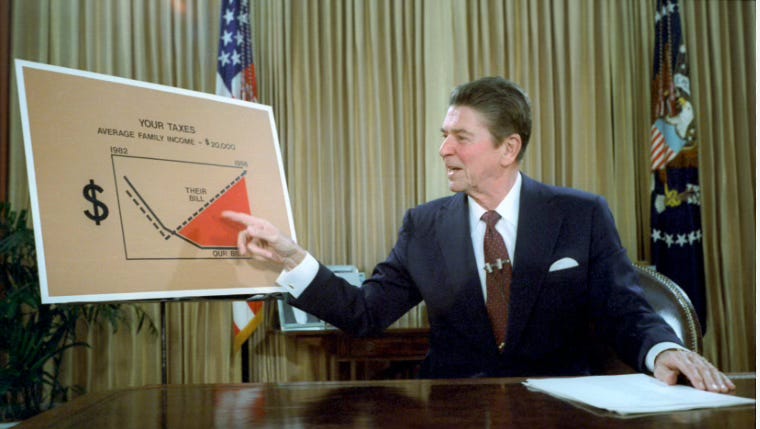
To understand the connection between tax policy and elections, we need to revisit the Economic Recovery Tax Act (ERTA) of 1981. Known as the Kemp-Roth tax cut, this legislation was one of the largest tax cuts in U.S. history. Signed by President Ronald Reagan on August 13, 1981, ERTA was the centerpiece of his economic plan, widely referred to as "Reaganomics." But what was in this landmark tax bill that promised to revamp the economy?
Key Features of the ERTA
ERTA’s provisions were rooted in supply-side economic theory, seeking to stimulate growth by encouraging businesses and individuals to invest and increase productivity. Its standout features included:
Reduced Marginal Tax Rates: The highest tax bracket was cut from 70% to 50%, while the lowest bracket dropped from 14% to 11%.
Capital Gains Tax Cuts: The top rate on capital gains was reduced from 28% to 20%.
Accelerated Depreciation Rules: Businesses were allowed to recoup investments in equipment more quickly.
Adjustments to Inflation: Tax brackets were indexed to prevent inflation from pushing taxpayers into higher brackets—increasing disposable income.
This bold fiscal policy aimed to kickstart the sluggish economy, but an unexpected dynamic came into play when the 1982 midterm elections arrived.
The 1982 Midterms
Despite the promise of ERTA, its economic benefits were slow to materialize, and the timing of its implementation proved politically costly. While the bill was signed in mid-1981, the cuts did not go into effect until October of that year. Further compounding the delay, the cuts were incremental, with the first year only providing a modest 5% reduction. As a result, by the time of the 1982 midterms, voters were still grappling with a severe recession, unemployment, and minimal visible improvements in their financial well-being.
The electoral consequences were significant:
The Democratic Party gained 26 seats in the House, solidifying their majority.
The Republicans' seat count dropped from 192 to 166, eroding the gains achieved during Reagan’s landslide 1980 presidential victory.
Analysts attribute this outcome partly to the lagging benefits of the tax cuts and the Federal Reserve's high-interest-rate policies. The lesson? Timing is everything. Delayed implementation diminished the positive economic impact voters hoped to see by election season.
The 2017 Trump Tax Cuts and the 2018 Midterms
Fast forward to 2017, when President Donald Trump signed the Tax Cuts and Jobs Act (TCJA) into law. This legislation echoed themes of Reagan's ERTA and aimed to reduce the tax burden on businesses and individuals. However, its political legacy mirrors the 1981 act in some striking ways.
What Did the 2017 Tax Cuts Include?
The TCJA was a sweeping reform that:
Reduced the corporate tax rate from 35% to 21%.
Adjusted individual tax brackets, lowering rates across the board.
Doubled the standard deduction.
Introduced new limits on deductions, such as the cap on state and local tax (SALT) deductions at $10,000.
From a policy perspective, the TCJA enhanced the global competitiveness of U.S. businesses and delivered financial benefits to many taxpayers. However, as with Reagan’s ERA, implementation timelines played a pivotal role in shaping its electoral influence.
The 2018 Midterms
The timing of the TCJA’s passage proved problematic for Republicans. Signed into law in December 2017, the law’s immediate effects were minimal by the time of the 2018 midterm elections. Much like the 1982 elections, economic conditions remained top-of-mind, and voters in key suburban districts voiced dissatisfaction.
Key outcomes of the 2018 midterms included:
The Republican Party lost 41 House seats, the largest net loss for the party since the Watergate scandal in 1974.
The Democratic Party regained control of the House for the first time in eight years.
Many moderate Republican incumbents failed to keep their seats, especially in suburban districts where tax policy changes, like the SALT deduction cap, were controversial. Despite Trump's claims that his rally efforts limited the damage, history repeated itself. Voters did not feel the full economic benefits of the TCJA in time for them to translate into electoral success.
As we highlighted just a month after our open letter in February, the Senate GOP risks losing its majority simply by engaging in its characteristic delays. For a deeper dive, take a look at our analysis from March of this year.
Lessons Learned from History
Both ERTA and the TCJA illustrate how critical timing is when designing tax cuts. Key takeaways for policymakers include:
Deliver Timely Results: Voters expect tangible benefits from policies they support. Delayed implementations risk alienating support ahead of elections.
Understand Economic Conditions: Tax policy cannot be evaluated in isolation. Broader economic factors, such as inflation and unemployment, heavily influence voter sentiment.
Communicate Clearly: Governments must explain the long-term goals and immediate benefits of tax cuts. When voters do not immediately see results, communication bridges the gap.
These lessons remain as relevant today as they were decades ago. Politicians should prioritize swift implementation of tax reforms and tailor messaging to meet constituents’ concerns.
The Future of Tax Policy and Elections
The link between tax policy and elections shows one simple truth: people vote with their wallets (most of the time). Economic issues often outweigh party loyalty, and understanding this is key for leaders juggling policy-making and campaign strategies.
Take the Reagan-era ERTA or Trump’s TCJA as examples—delays in delivering benefits hurt their parties at the polls. Future tax reforms need to focus on timing and clear communication so voters actually feel the impact before Election Day.
At the end of the day, elections are about the perception of progress. By learning from the past and making smart decisions, policymakers can create tax policies that not only boost the economy but also build trust with voters.
Will the Senate act before July 4th to pass the Big, Beautiful Bill? Will they make it retroactive to January 20th? Both measures are crucial in today’s economic climate. We’re keeping a close watch!


