The Anatomy of the NCAA Upset:
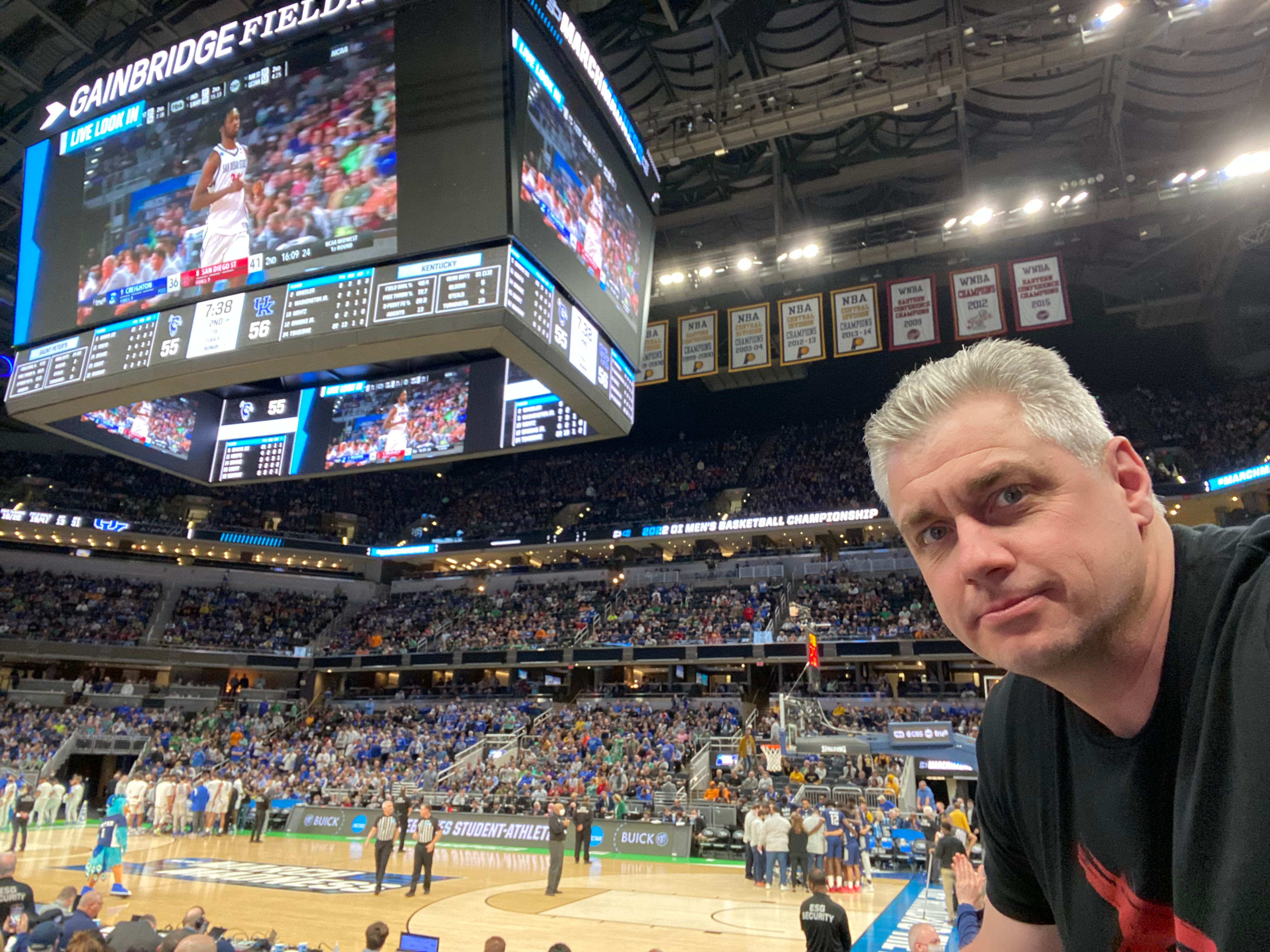
As we kickoff the 2026 NCAA tourney, I have had the distinct privilege of witnessing the impossible twice in person: standing in the arena in Indianapolis in 2022 as #15 St. Peter’s stunned #2 Kentucky, and again in Columbus in 2023 as #16 FDU dismantled #1 Purdue. There is a specific, palpable shift in the atmosphere when a giant begins to realize they are in trouble—a transformation of the air itself from celebration to suffocating pressure. These experiences weren’t just games; they were masterclasses in the psychology of the underdog, providing a front-row seat to the moment the “expectation weight” finally snaps a favorite’s resolve. Since I am a NCAA tourney junkie, please allow me to share.
1. Introduction: The Game Within the Game
In the high-stakes crucible of the NCAA Tournament, an upset is not a fluke or a statistical glitch; it is a meticulously manufactured psychological collapse. To understand how a 15-seeded St. Peter’s or a 16-seeded FDU can systematically dismantle a “Blue Blood” roster, we must look through a scientific lens at the neurobiology of the “One-and-Done” era.
Since the 2006 eligibility shift, elite programs have built their foundations on 18 and 19-year-old phenoms. While possessive of lottery-pick talent, these players operate under a precarious psychological profile. When a seasoned underdog disrupts their rhythm, we witness a “narrowing of the cognitive field.” Elevated cortisol levels—the body’s primary stress hormone—flood the favorite’s system, replacing fluid instinct with rigid decision-making and unforced errors. As a strategist, I view this as an “upset cheatsheet” where Cinderella stories are built possession by possession, and the clock is transformed from a timer into a weapon of psychological warfare.
2. The Anatomy of a Mismatch: Talent vs. Burden
Before the first whistle blows, the “expectation weight” of a premium seed creates a volatile cognitive environment. The favorite isn’t just playing a game; they are defending a brand, a legacy, and their own draft stock.
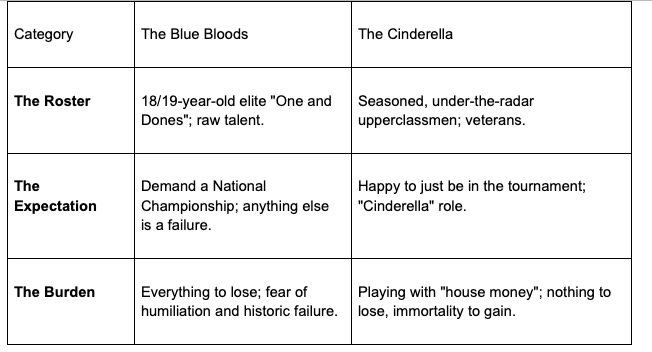
These pre-game factors set the stage for a psychological battle where the “expectation weight” becomes a physical anchor on the favorite as the game progresses.
3. Joe DeSena’s Mental Framework: Shattering the Iceberg of Pain
To neutralize a massive talent gap, elite underdog coaches implement the “Telephone Pole” strategy synthesized by Joe DeSena in Spartan Up. Yes, see I even incorporated a book into this post! How cool, right? Ha!
The core philosophy is compartmentalization. An underdog cannot survive by looking at the daunting 40-minute prospect of facing a Goliath; the mind simply cannot process that “massive iceberg of pain” without shattering.
Instead, the game is deconstructed into “bite-sized nuggets”—specifically, the four-minute spurts between media timeouts. DeSena’s framework provides the mental armor necessary to endure the grind:
“The way to get through anything mentally painful is to take it a little at a time... instead of thinking, ‘Ah, I’ve got 24 miles to go in this marathon,’ focus on making it to the next telephone pole in the distance... the ability to compartmentalize pain into these small bite sizes is key.”
By focusing only on the next telephone pole, the underdog prevents cognitive overload and protects their “Mojo.” These mental poles find their physical manifestation in the four critical NCAA TV timeouts of the second half. The great coaches continually remind their players in the media timeouts of this physiological nature of the game.
4. The Four Pillars of Momentum: Second-Half Benchmarks
The second half is where “belief maintenance” transforms into a tactical execution. These four media timeouts act as the barometers of an impending miracle.
Under-16:00 (Adjustment Validation): This mark tests the underdog’s ability to survive the favorite’s “halftime punch.” If the underdog withstands defensive shell changes and remains within a 10-point striking range (the Scoreboard Delta), they validate their right to be on the floor.
Under-12:00 (Belief Maintenance): Here, the underdog’s neuro-feedback loops stabilize. They shift from “hanging around” to actively “executing.” Confidence grows exponentially, manifesting in visible huddle chatter and increased intensity.
Under-8:00 (The Pressure Shift/The Pivot): The most critical juncture, the Expectation Gap. The 18-year-old favorites look at the clock and realize they might actually lose. The fear of embarrassment supersedes the drive for victory. The favorite begins playing “not to lose,” leading to rigid shooting strokes and hesitation.
Under-4:00 (The Nation’s Attention): The game enters the national collective consciousness. The “Cinderella” narrative takes over, and the arena environment becomes hostile to the panicked favorite as the crowd rallies behind the miracle.
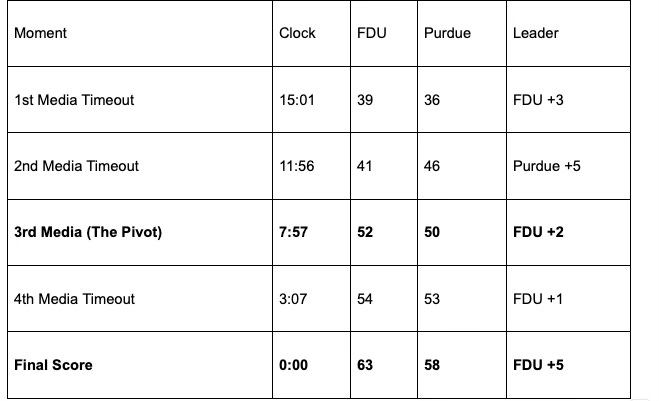
These theoretical benchmarks are validated by real-world data logs, proving that the underdog wins by dominating the clock in a meager five sections of basketball in the second half of the game.
5. Historical Case Studies: Theory in Action
St. Peter’s vs. Kentucky (2022)
The 15-seed St. Peter’s Peacocks provided the blueprint for mastering “expectation weight.” They maintained a clinical mental baseline, keeping the “Blue Blood” Wildcats within striking range for 40 minutes. Ironically, they used the Kentucky crowd—which filled 90% of the arena—as fuel. As the game reached the Under-8:00 mark, the silence in the stands became “deafening.” Kentucky players looked into the stands, saw the mounting fear in their fans’ eyes, and mirrored that rigidity on the court, allowing the Peacocks to execute their way into history.
FDU vs. Purdue (2023)
The 16-seed FDU Knights demonstrated the power of the “Pivot.” After Purdue mounted a second-half run to lead 46-41, veterans Demetre Roberts and Grant Singleton refused to yield. They stabilized the offense and reclaimed the lead by the critical 7:57 mark.
Observing these patterns requires looking beyond the flight of the ball and focusing on the behavioral cues of the players themselves.
6. The Observer’s Tactical Guide: Identifying Behavioral Cues
To predict an impending upset, use this “watch guide” to identify when a favorite is “tightening” and an underdog is finding their “Mojo.”
Red Flags for Favorites (The “Tighten” Signs)
Visual Panic: Players frequently glancing at the clock or scoreboard before the 8-minute mark.
Physical Tells: High-frequency palm-wiping on jerseys and avoided eye contact during huddles as cognitive load increases.
Stagnant Offense: Shifting to a “safe” perimeter game, attempting to drain the clock rather than remaining aggressive.
Green Lights for Underdogs (The “Mojo” Signs)
Huddle Intensity: Increased vocal leadership, high-fives, and “knuckle bumps” during the Under-12:00 mark.
Tactical Resilience: Executing counter-adjustments, such as switching to a “zone” or “defensive shell” to frustrate interior stars.
Tempo Control: Deliberate “shot-clock drain” strategies to limit possessions and increase outcome variance.
These cues serve as a “upset watch is turning to an upset warning” for the final minutes of the contest.
7. Conclusion: Executing the Miracle
The “Anatomy of the Upset” confirms that disciplined compartmentalization beats raw, overwhelmed talent. By navigating the “Iceberg of Pain” and meeting specific temporal benchmarks, the underdog moves from the possibility of a win to the probability of an immortal legacy.
The Upset Benchmark Tracker
Monitor these markers to identify an impending miracle in real-time:
[ ] Scoreboard Delta: Did the underdog keep the first-half gap under 10 points?
[ ] The 16:00/12:00 Poles: Did the underdog withstand the favorite’s “best punch” and stabilize their neuro-feedback loops?
[ ] The Expectation Gap (8:00): Is the favorite playing “not to lose” to avoid humiliation while the underdog remains aggressive? If so, this is critical juncture of the game–the pivot as we called it above. The upset watch will become an upset warning–meaning all conditions are being meant for the favorite to lose.
[ ] National Attention (4:00): If the underdog is within 9 points or less, national attention will pivot to this game, the local crowd in the arena will get behind the underdog in overwhelming fashion. I saw this first hand and in person in 2022 in Indianapolis with #15 St. Peters defeating #2 Kentucky despite a large KY fan base on hand, and even more so with watching in person #1 Purdue go down to #16 FDU in Columbus, Ohio in the 2023 NCAA opening round. The one question to keep in mind during this critical time period, is can the overwhelming favorite execute at a very high level for these 4 minutes with all the pressure on them to gain victory?
[ ] The Dagger (Final 2:00): Is the underdog executing a high-stakes play (like Sean Moore’s layup at the 1:38 mark) while the favorite is mentally paralyzed?
If you watch to check out the video around this theme, here’s that video
In the NCAA tournament, the clock is not just a timer; it is the underdog’s most potent weapon. Watch the telephone poles, look for the pivot and be ready to watch another NCAA upset. Enjoy this year’s games!


