What Happens After a Legend Leaves?
The Quick Version
In big-time college basketball, replacing a legendary coach is usually a nightmare. Most programs fall apart or at least take a huge step back because it’s almost impossible to live up to the “ghost of greatness.” However, what we’re seeing at Duke with Jon Scheyer taking over for Coach K is actually pretty rare—he’s not just surviving; he’s crushing it.
The truth is, coaching changes don’t always move the needle as much as fans think. Most of the time, a new hire only leads to a small bump or a slight dip in wins. But at “Blue Blood” schools worth over $350 million, those tiny margins are everything—they’re the difference between staying at the top or falling into a slump.
--------------------------------------------------------------------------------
I. Theoretical Framework: Factors Influencing Coaching Success
A longitudinal study of 736 NCAA Division I coaching changes between 1999 and 2014 identifies several critical factors that dictate program performance following a leadership transition.
The “Big Three” Succession Theories
Vicious Circle Theory: Argues that leadership changes are counter-productive, destabilizing the environment and reducing effectiveness through continued replacement.
Common Sense Theory: Suggests that changing leadership improves performance by providing renewed enthusiasm and progress.
Ritual Scapegoating Theory: Predicts that coaching changes have little to no impact on performance because coaches have limited influence over securing talent or changing established culture.
Empirical Determinants of Performance
The data shows that things we usually think matter—like a coach’s age, where they went to school, or even how well they played back in the day—don’t actually move the needle much. When you dig into the numbers, the real keys to winning come down to just a few specific things:
Previous Program Success: Elite programs often experience a “regression to the mean.” Programs with high success but no NBA-level talent see an average decrease of 1.17 wins per year following a change.
Individual Coaching Ability: Measured by career win differentials, the innate ability of the coach remains a significant predictor.
Vacancy Circumstance: Changes following negative performance (firing) often lead to small positive win differentials (approx. 0.78 wins), whereas changes following positive performance (a coach leaving for a better job) often result in a decline (-0.6 wins).
--------------------------------------------------------------------------------
II. The Succession Paradox: Historical Precedents
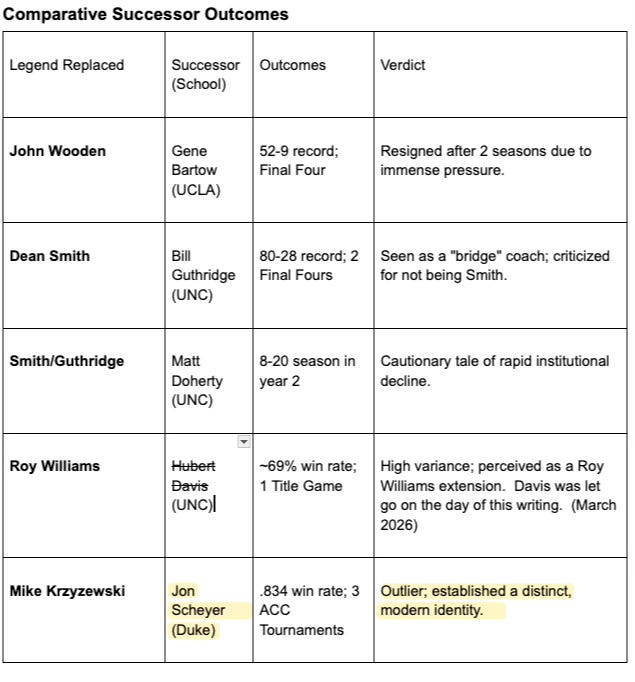
Check this out: trying to step into the shoes of a coaching icon is easily one of the toughest jobs in all of sports. Between the impossible expectations and the cold, hard math of trying to maintain peak performance, most successors find themselves set up for a major fall.
Comparative Successor Outcomes
--------------------------------------------------------------------------------
III. The Duke Paradigm: Jon Scheyer’s Modern Blueprint
Jon Scheyer’s tenure (2022–2026) has defied the historical pattern of failure. Through four seasons, he achieved a .834 winning percentage and became the fastest coach in ACC history to reach 100 victories.
The Five Pillars of the Scheyer Model
Tactical Modernization: Moved from Mike Krzyzewski’s signature high-pressure perimeter defense to an analytical system prioritizing rim protection. Duke now allows higher three-point attempt percentages (ranking 329th) to keep elite big men near the basket, resulting in the No. 1 defensive efficiency rating nationally.
Organizational Science: Rather than mimicking Krzyzewski’s intuitive leadership, Scheyer consulted with Duke business school psychologists to build a repeatable scientific model for managing human behavior and organizational rationality.
“Live Read” Player Development: Abandoned scripted drills and cones in favor of workouts featuring “live bodies” and real-time decision-making to accelerate the learning curve of young players.
Operational Adaptability: Hired external experts (including a Nike executive) to navigate the NIL (Name, Image, and Likeness) and transfer portal era. Employs “brutal transparency” and “truth conversations” rather than false promises to manage roster turnover.
Positional Length Recruiting: Recruits exclusively for extreme size and switchability, with a regular rotation where the shortest player is 6-foot-4.
Statistical Dominance (2025–2026 Season)
Overall Record: 32-2 (NCAA No. 1 Overall Seed).
Efficiency: Ranked 1st in Defensive Efficiency and 5th in Offensive Efficiency (KenPom).
Scoring Margin: +20.5 (1st in NCAA).
Roster Turnover Management: After losing the entire 2024-25 starting lineup to the NBA, Scheyer coached a new roster to 32 wins and an Elite Eight appearance.
--------------------------------------------------------------------------------
IV. Key Insights and Strategic Takeaways
The “Clean Break” vs. Just Keeping Things Going
One of many examples, is the big difference between Duke and UNC is how they handled the coaching transitions. Jon Scheyer succeeded because he wasn’t afraid to throw out the old playbook and start fresh for today’s game. Experts often said this year that Hubert Davis needed to do the same and “step out of the shadow” of who came before him to really modernize the program but he was unable to do that.
Does Coaching Really Matter That Much?
The research actually shows that a coach doesn’t change the win-loss record as much as we think. Most of the time, a new hire only leads to a small bump or a slight dip. But at “Blue Blood” schools worth over $350 million, those tiny margins are everything—they’re the difference between staying at the top or falling into a slump.
Finding a Long-Term Winner
The transition from a legendary figure is a high-wire act that is far more precarious than it appears from the outside. What makes this particular era so compelling to watch is how Scheyer has managed to maintain an elite standard while fundamentally rewriting the program’s DNA, proving that a successful handoff requires both reverence for the past and the courage to abandon it.



