When the Shepherd Negotiates with the Wolf, part 1 of 2
Back in May of 2022, I recorded a Catholic Corner segment on the Theory 2 Action podcast about the day Hong Kong’s National Security Police arrested a 90-year-old cardinal. (Catholic Corner #8, recorded May 16, 2022.)
I called the Vatican’s response flimsy then. I said their four-year China project had been unremarkable, to say the least. I asked why in the world Rome would enter into an agreement this dismal, and with the Communist Party of China?! I said Pope Francis would do well to invite Cardinal Zen to Rome and actually learn from a man who’d spent his whole life studying this godless regime up close.
By February of 2023, I recorded another Catholic Corner segment with an update, and it wasn’t a good one. (Catholic Corner #20, recorded February 8, 2023.) Cardinal Zen, now 91, had just been hospitalized in Hong Kong after returning from Pope Benedict XVI’s funeral in Rome. He’d finally gotten a private meeting with Pope Francis at that funeral — the first time the two men had spoken face to face since Zen requested one, in writing, back in 2017. Six years of silence, broken only because they happened to be in the same city for a burial.
I said then that Vatican foreign policy toward the largest country in the world was a wreck. I said it lacked any direction and amounted to a betrayal of the authentic Chinese Catholic Church. I even asked, out loud, whether history might one day remember Pope Francis less as a shepherd to China’s faithful than as Chairman Xi’s pope.
Three years later, I wish I’d been wrong.
Cardinal Joseph Zen is 94 years old.
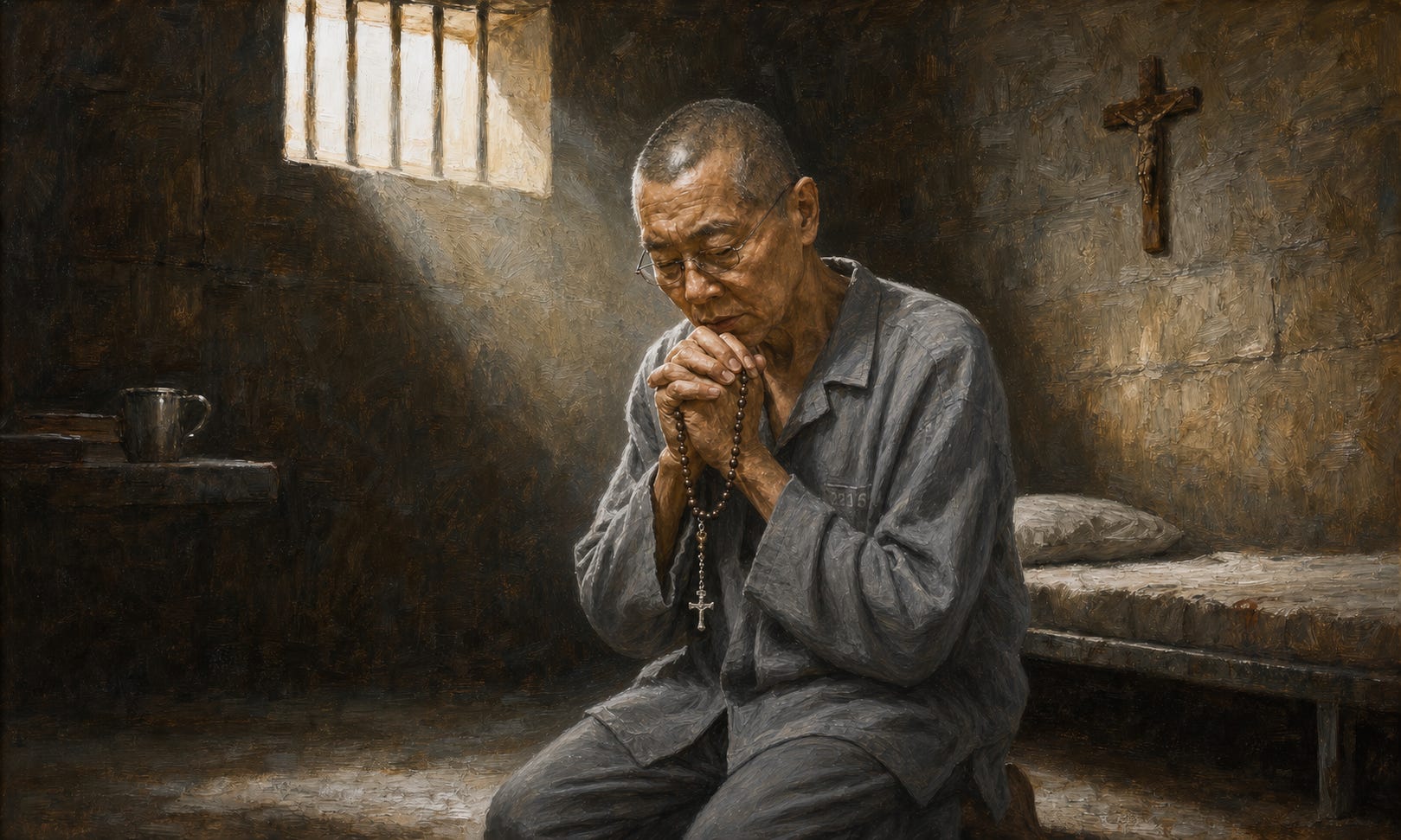
On February 9, 2026, he walked into a Hong Kong courtroom to stand with the family of Jimmy Lai. A 78-year-old Catholic, baptized by Zen himself in 1997. A newspaper owner who spent his life defending free speech and the rule of law in Hong Kong.
Lai walked out with a 20-year sentence. Effectively, a life sentence. His daughter called it “heartbreakingly cruel.” His son called it a death sentence in slow motion.
And where was Rome?
Silent. Again.
Make that literal. A month after the sentencing, a reporter finally got Pope Leo XIV to address it directly, catching him outside the papal villa at Castel Gandolfo. His answer: “I cannot comment.” He pivoted to a general call for “less hatred and more peace” and took no further questions on it. It was the first time he’d spoken to press at all since the previous December.
He’d met with Lai’s wife and daughter back in October. He has spoken, in the abstract, about the courage of imprisoned journalists everywhere. On the specific Catholic sentenced to a life term for defending the freedoms of his own city, the pope who now holds Zen’s file chose three words: cannot comment.
Commentators have started calling it a conspiracy of silence. Hong Kong’s own current bishop, Stephen Chow, has taken the same posture — he says he prays for Lai, but avoids public advocacy while the case winds through what Beijing still calls its judicial system.
Compare that to a 94-year-old retired cardinal who showed up at the courthouse anyway.
This is the story you need to understand. Not because it’s abstract Vatican politics.
Because it’s a test case for something every one of us faces: what happens when an institution trades moral clarity for a seat at the table with tyrants.
The deal nobody has ever read
In 2018, the Vatican signed a “provisional agreement” with the People’s Republic of China on the appointment of bishops.
Here’s the first thing you need to know: nobody outside the negotiating room has ever seen the full text. Not journalists. Not most cardinals. Not the underground Catholics whose lives it governs.
What we do know: it gives Beijing a formal role in selecting China’s Catholic bishops, with Rome retaining a veto. Pope Francis lifted the excommunications of seven government-approved bishops the same week it was signed.
The deal has been renewed three times. Most recently in October 2024, when the Vatican and Beijing extended it not for two years, as before, but for four. Analysts called the longer term a sign of a “new level of trust” between the two parties.
Trust. That’s the word the diplomats used.
Here’s what the Chinese Communist Party did with that trust:
In 2022, Beijing installed a bishop in a diocese the Vatican doesn’t even recognize, without asking Rome. The Vatican learned about it after the fact.
In 2023, Beijing transferred another bishop to Shanghai the same way. Again, without the Vatican’s prior knowledge or approval.
A Hudson Institute report found seven Catholic bishops in China have been detained without due process, with others facing surveillance and police pressure, in the six years since the deal was signed.
Even the Vatican’s own foreign minister, Archbishop Paul Gallagher, has called it “not the best deal possible.”
That’s Rome’s own diplomat. Grading his own agreement a C-minus. Others, looking at the first eight years of this debacle, grade it as a firm F.
Cardinal Zen saw it coming before the ink was even dry. From his book, “For Love of My People I Will Not Remain Silent”:
“To us, a terrifying scenario is unfolding, the sellout of our Church! There is no essential freedom but a semblance of freedom. Not reconstituted unity, but a forced cohabitation in the cage. From the point of view of the faith, we cannot see any gain. The agreement appears to contain three parts: 1. The manner of appointing Bishops 2. The status of the seven ‘illegitimate Bishops’ 3. The future of the ‘underground’ community”
Why this deal is structurally bad
Strip away the theology and the diplomatic language, and the structure of this deal has five problems that would sink it in any negotiation:
It’s secret, so it kills trust. The text has never been published. Catholics in China, and everyone else, are asked to trust a bargain they’re not allowed to see.
Beijing gets real power. Rome gets a veto it’s never used. In practice, Beijing proposes the bishops. Rome’s veto exists on paper, but even after documented violations, it has never actually been exercised.
It accelerates the crushing of the underground Church. Human Rights Watch has documented how the agreement pressures underground communities into the state-controlled Patriotic Association, alongside arrests, disappearances, demolished churches, and crosses torn down.
It compromises Rome’s prophetic voice. Because the deal exists and keeps getting renewed, the Vatican has stayed conspicuously quiet on Jimmy Lai, on disappeared bishops, on Hong Kong’s crackdown.
It gets renewed in the middle of intensified persecution, not despite it. Xi’s “Sinicization” campaign has ramped up surveillance and ideological training on both the underground and official Church, in the same years the Vatican keeps affirming and extending the pact.
Boil it down and the trade is this: Rome gives up secrecy, silence, and moral standing, in exchange for a fragile say in appointments that Beijing ignores whenever it’s inconvenient.
The Reichskonkordat problem
This isn’t the first time Rome has tried this play, and serious Catholic commentators — not just polemicists — have started saying so out loud, drawing a direct line to the 1933 Reichskonkordat, the concordat the Holy See signed with Hitler’s Germany.
The parallel, as critics lay it out:
Same bargain structure. In 1933, the regime promised to respect Church rights if Rome stayed out of politics. In 2018, Beijing promised a managed process for bishops. Both times, Rome hoped a signed paper would buy safety for its institutions.
Same moral tension. In both cases, the Church tried to secure room for sacramental life by accommodating a regime that persecutes everyone else and demands ideological conformity.
Same pattern of broken promises. The Nazis violated the Reichskonkordat almost immediately while keeping it technically on the books. Beijing has done the same to the China deal — unilateral bishop transfers, intensified repression, harassment of the underground Church — while Rome keeps renewing it anyway.
Here’s the nugget of wisdom underneath both stories, and it’s not complicated. Members of Communist parties lie. Not occasionally, not under unusual pressure — lying to negotiators is standard operating procedure, because the Party recognizes no truth higher than its own survival and advancement.
That was true of the men Pius XI signed with in 1933. It’s true of the men Rome has renewed a deal with three times since 2018. Any diplomacy that treats a signature from that kind of regime as a durable guarantee has already misread who’s sitting across the table.
To be fair to the historical record, the analogy isn’t a perfect match, and it’s worth saying so plainly:
Nazi Germany’s persecution accelerated into a continent-wide war and genocide; China’s repression runs through high-tech surveillance and “Sinicization” campaigns rather than that specific trajectory.
The Reichskonkordat was a full diplomatic treaty with sweeping guarantees; the China agreement is narrower on paper, limited to bishop appointments, even if its effects ripple through the whole Chinese Church.
The 1930s had far fewer watchdogs and NGOs than exist today, which is exactly why Rome has less excuse this time for not seeing where the pattern leads.
Where the comparison holds is the part that matters most: an institutional concordat with an authoritarian regime, and the regime breaking the spirit of it while Rome stays entangled and the innocent keep paying the price.
What Pius XI did when he realized he’d been lied to
Here’s the part of the Reichskonkordat story that Rome’s current diplomats seem to have forgotten: the pope who signed it didn’t stay quiet once he saw what the Nazis actually intended.
Pius XI went into the 1933 concordat with real misgivings, hoping a treaty would at least secure some legal protection for German Catholics. It didn’t take long to see the truth.
Almost immediately, the regime went after Catholic schools, youth groups, and lay organizations, arresting priests on trumped-up charges and shutting down the Catholic press piece by piece. By 1937, the German bishops themselves were done pretending this was a partnership and pushed Rome to act.
Pius XI acted. He commissioned an encyclical, written in German instead of the Church’s customary Latin so ordinary Catholics could understand every word of it without a translator. Smuggled into the country to dodge Nazi censors, it was read from every Catholic pulpit in Germany on Palm Sunday, 1937. It accused the regime of “fundamental hostility to Christ and His Church” and named the specific concordat violations one by one. It condemned the Nazi worship of race and blood as idolatry. And it warned of the “threatening storm clouds” already gathering over Germany.
Hitler’s response tells you everything about how much that public rebuke cost the Church, and how much it was worth paying. The Gestapo rounded up the printers. Possession of a copy became a crime. Priests who’d distributed it were arrested. The regime escalated its war on the Church rather than backing down, and Pius XI let it escalate rather than pretend the treaty still meant what it said on paper.
That’s the model. Not silence dressed up as prudence. A pope who signed a bad deal, watched the other side lie to his face about honoring it, and then said so publicly, in the language his flock actually spoke, from every pulpit he could reach.
The Two Cardinals need to go
Which brings me to a harder point, and I’m not going to soften it. The men who have run this debacle for Rome need to go.
Cardinal Pietro Parolin has been Secretary of State since 2013 and was one of the chief architects of the 2018 deal itself. Cardinal Zen said it plainly back in 2018: Pope Francis may not fully understand the Chinese Communist Party, but Parolin has no such excuse.
He was in the Secretariat of State for decades. He knows exactly who he’s dealing with, and he built this agreement anyway, then kept defending it through three renewals and a stack of broken promises.
Cardinal Víctor Fernández, now running the Vatican’s doctrinal office, is part of the same senior leadership class that has let this posture of accommodation calcify into policy across the Curia, year after year, regardless of the cost to the faithful in China. I no longer trust either man’s judgment on how this Church treats the people persecuted for their faith and Pope Leo shouldn’t either.
At a certain point, a track record isn’t just a track record. It’s a disqualification. Rome doesn’t need new talking points from these men. It needs new men in these chairs.
I’ll give Pope Leo XIV his due: he’s been gracious. New pontiffs get a customary grace period, usually about a year, to keep the previous pope’s department heads in place while they get their footing. That’s normal. That’s fair.
But that window is closing, and in some cases it’s already closed.
Every month Leo lets Parolin and Fernández keep running their departments unchanged is a month he’s choosing to own this file himself. “Cannot comment” was a weak answer in March. It gets weaker every month it remains his answer.
A new pope inherits a diplomatic mess. He does not have to inherit the men who built it, and the longer he keeps them, the more this becomes his mess, not Francis’s.
Later this week, in Part 2: Cardinal Zen in his own words, the bishops Rome still won’t name, and two books that will arm you to see this whole mess clearly.
Keep fighting the good fight.


