Why Three Significant Events Led to the Strike on Iran's Nuclear Sites
The 21st century has seen constant tensions around Iran’s nuclear ambitions, which have had a huge impact on global politics. For years, world leaders have struggled to balance regional stability while trying to stop Iran from advancing its nuclear capabilities. In my opinion, three key events led to a major turning point in June 2025, when U.S. warplanes and submarines launched coordinated strikes on Iran’s nuclear infrastructure. In this piece, I’ll walk you through these moments and how they changed the course of geopolitics..
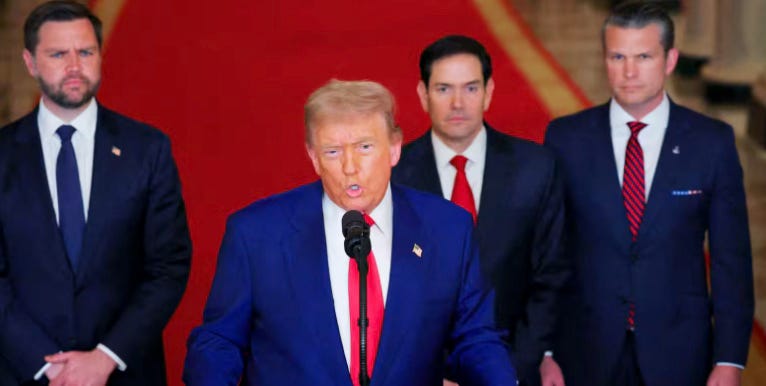
Why did the Americans along with the Israeli's finally act decisively against Iran's nuclear development? The answer lies in examining three key events, each a turning point that underscored escalating tension and the necessity for a firm response.
First, the dovish foreign policies of the Obama and Biden administrations created an environment where Iran could expand its nuclear ambitions under the guise of negotiation. Second, the October 7, 2023, attack on Israel by Hamas demonstrated, with brutal clarity, Iran's destabilizing influence on the Middle East through its proxy Hamas. Finally, the election of Donald Trump in November 2024, combined with a sobering report from the International Atomic Energy Agency (IAEA) in May 2025, introduced new leadership with a hardline stance and undeniable evidence of Iran’s nuclear acceleration. Together, these events made inaction impossible.
Below, we unpack these moments, showing how they connected to shape history.
1. Dovish Policies of Obama and Biden
For nearly a decade, the foreign policies of the United States were marked by optimism and commitment to diplomacy when it came to Iran. While the motives behind this approach were rooted in avoiding conflict, the consequences proved far from ideal.
The Obama Administration (2009–2017)
During Barack Obama’s presidency, the focus on diplomacy culminated in the 2015 Joint Comprehensive Plan of Action (JCPOA). This agreement was celebrated as a breakthrough in preventing Iran from developing nuclear weapons. The JCPOA imposed restrictions on uranium enrichment, reduced Iran's centrifuge stock, and extended its nuclear "breakout time"—the amount of time needed to produce a nuclear weapon.
While praised by some for averting immediate conflict, the deal was laden with loopholes. Critics argued that the agreement merely postponed the inevitable. Most notably, the JCPOA allowed Iran to maintain its nuclear infrastructure, and much of its terms were set to expire over time. Iran's compliance was also tenuous, as evidenced by instances of secrecy and a lack of transparency in allowing nuclear site inspections.
The Biden Administration (2021–2025)
When Joe Biden assumed the presidency in 2021, he sought to revive the JCPOA, which Donald Trump had abandoned and ripped up in 2018. Biden’s administration engaged in indirect talks with Iranian officials to negotiate a return to the agreement. By focusing on diplomacy, Biden aimed to reinstate trust and prevent escalation.
Unfortunately, these renewed efforts bore little fruit. By 2023, Iran had openly violated past agreements, proceeding to enrich uranium beyond JCPOA limits. Reports revealed Iran possessed 22 times the amount of enriched uranium permitted under the deal. The U.S. response was limited to sanctions, with no significant impact on curbing Iran’s hardline ambitions.
Yes, you read that right—22 times the amount of the JCPOA!!
Book Recommendation: "The Back Channel" by William J. Burns (2019)
This memoir, written by a former U.S. diplomat and Obama’s Deputy Secretary of State, gives an inside look at American diplomacy. It focuses on the secret talks with Iran that led to the JCPOA, highlighting Obama’s push for diplomacy over military action—even with challenges like Iran’s ties to groups like Hezbollah. Chapters 10–12 are especially fascinating and revolting at the same time, diving into the negotiations, Obama’s strategy, and the doubts from allies like Israel (rightly so--because Obama was being played for a fool). If you’re curious about how Obama let down the American people and the global community, this is a great place to start..
The Consequences
These diplomatic overtures, while intended to stabilize relations, ultimately emboldened Iran. Tehran perceived the West’s reluctance for military action as a sign of weakness, allowing it to advance its nuclear objectives under the pretense of good-faith negotiations.
The result was a more powerful and assertive Iran, poised to leverage its nuclear capability as a tool of aggression in a volatile region. The stage was set for future conflict.
2. The October 7, 2023, Attack on Israel "Black Saturday"--Israel's 9/11
As diplomacy faltered, the Middle East experienced a shocking escalation on October 7, 2023. That morning, Hamas launched its most devastating attack on Israel to date, known as "Operation Al-Aqsa Flood." The impact reverberated globally.
It was Israel's 9-11 moment and the world should have known they would respond accordingly!
Hamas’s Unprecedented Attack
On this day, Hamas, a Palestinian militant group backed by Iran, coordinated rocket attacks and a ground assault that killed 1,200 Israelis and resulted in over 200 hostages being taken. The sheer scale and brutality of the attack shocked not only Israel but also its allies worldwide. Many began questioning how such an operation could succeed without significant external support.
we covered this on the podcast click here for that playlist of episodes--Black Saturday one year later
Iran’s Role and Proxy Strategy
The attack cast a harsh spotlight on Iran’s involvement in funding and arming militant groups throughout the region. While Iran did not participate directly, its role as a behind-the-scenes benefactor became undeniable. Tehran’s strategy relied on supporting proxies like Hamas and Hezbollah, using them as tools to destabilize Israel and expand its influence.
For years, this indirect approach allowed Iran to avoid direct condemnation from global powers. However, the October 2023 attack unveiled the dangerous extent of its influence. Israel retaliated with "Iron Swords War," devastating Hamas’s infrastructure but also signaling a broader regional conflict.
Implications for the Middle East
Regional dynamics shifted irreversibly. By 2024, Israel had systematically diminished Iran-backed proxies, including Hezbollah in Lebanon and remnants of the Assad regime in Syria. These victories disrupted Iran’s regional strategy, leaving Tehran isolated and desperate.
Iran’s response? To escalate its nuclear program dramatically. By May 2025, the IAEA reported that Iran possessed 408.6 kilograms of 60% enriched uranium, a threshold dangerously close to weapons-grade material. The Middle East teetered on the edge of a nuclear conflict.
Through the events of October 7, it became clear that Iran’s ambitions were more than theoretical. Military action was no longer avoidable; it was a prerequisite for regional stability.
Book recommendation: Black Saturday: An Unfiltered Account of the October 7th Attack on Israel and the War in Gaza" by Trey Yingst (2024).
Trey Yingst's book delivers a powerful firsthand account of the October 7, 2023, Hamas attack and the ensuing Gaza war. Based on his frontline reporting, it vividly captures the devastation, including the massacre of Israelis, hostage abductions, and Israel’s response. Blending personal reflections and interviews, the book examines the humanitarian crisis in Gaza and the conflict’s regional impact. Published in October 2024, it’s praised for its emotional depth, gripping narrative, and insight into the brutality of Israel's neighbors!
3. Trump’s Election and the IAEA’s May 2025 Report
The final push for decisive action came from a combination of political change and irrefutable evidence. Donald Trump’s victory in the November 2024 election, followed by a damning report from the IAEA in May 2025, left no room for complacency.
Trump’s Return to Power
Trump’s return to the presidency marked a stark policy shift. His administration viewed Iran not through the lens of negotiation, but as a direct adversary. Campaign rhetoric had promised "maximum pressure" and warned of severe consequences for nations defying nuclear regulations.
Taking office with this mindset, Trump wasted little time in aligning national security goals with his hardline stance. Close partnerships with Israel, Saudi Arabia, and other regional allies reinforced a coalition committed to neutralizing Iran’s nuclear threat.
The IAEA Report and Its Alarming Revelations
While political will had shifted, the reality of Iran’s progress toward nuclear weaponization provided a sense of urgency. The IAEA’s May 2025 report revealed unsettling details:
Iran’s stockpile of 60% enriched uranium had increased by 50% since February 2025.
At current enrichment rates, Iran could produce enough weapons-grade uranium for seven nuclear warheads per month.
Advanced nuclear technology was being deployed at suspected undisclosed locations.
The report concluded that Iran was fast approaching the capability of a fully functional nuclear arsenal. Unlike previous warnings, the findings in 2025 were unambiguous, leaving the international community little choice but to respond.
Strikes Become Inevitable
With these alarming developments, the Trump administration coordinated with Israel to prepare targeted strikes on Iran’s nuclear facilities. By June 2025, Operation Rising Lion commenced. The joint effort aimed to degrade Iran’s nuclear infrastructure and prevent it from producing weapons-grade material.
This bold move came at great risk, but it reflected a long-overdue recognition that diplomacy alone could not overcome Tehran’s ambitions.
Book recommendation: "Shadow Strike: Inside Israel's Secret Mission to Eliminate Syrian Nuclear Power" by Yaakov Katz (2019).
This book explores Israel's 2007 airstrike on Syria's al-Kibar nuclear reactor (Operation Outside the Box) and its connection to the Begin Doctrine, a policy aimed at preventing adversaries from acquiring nuclear weapons. It highlights the strategic success of the operation, which avoided escalation through a strategy of deniability. The book explores the potential implications for Iran, questioning whether Israel might take similar action against its nuclear program, as seen recently with American support..
Why Action Was Necessary
When viewed as a whole, the necessity of the June 2025 strikes becomes clear. Years of delayed responses under Obama and Biden allowed Iran to gain ground. The October 7 attack revealed Tehran’s growing destabilizing influence, while the Trump administration and IAEA report delivered the necessary political determination and proof to act.
The strikes were not a sudden decision but the product of years of escalation and failed strategies. They represented a commitment to halting what had long been a looming threat.
What lessons can we draw from this sequence of events? When dealing with adversaries who exploit delay and negotiation, decisive leadership often becomes the only viable answer.
Final Thoughts
The road to the June 2025 strike on Iran’s nuclear sites was a complex one. It was paved by years of appeasement, marked by moments of catastrophic violence, and sealed by undeniable evidence of an imminent nuclear threat.
Each of the three key events discussed here played a vital role in the ultimate decision to act. Together, they illustrate why procrastination in the face of danger only increases the cost of addressing it later. The lesson is simple yet profound—sometimes, action is the only path to peace.


