Is Germany Starting a New Reformation?
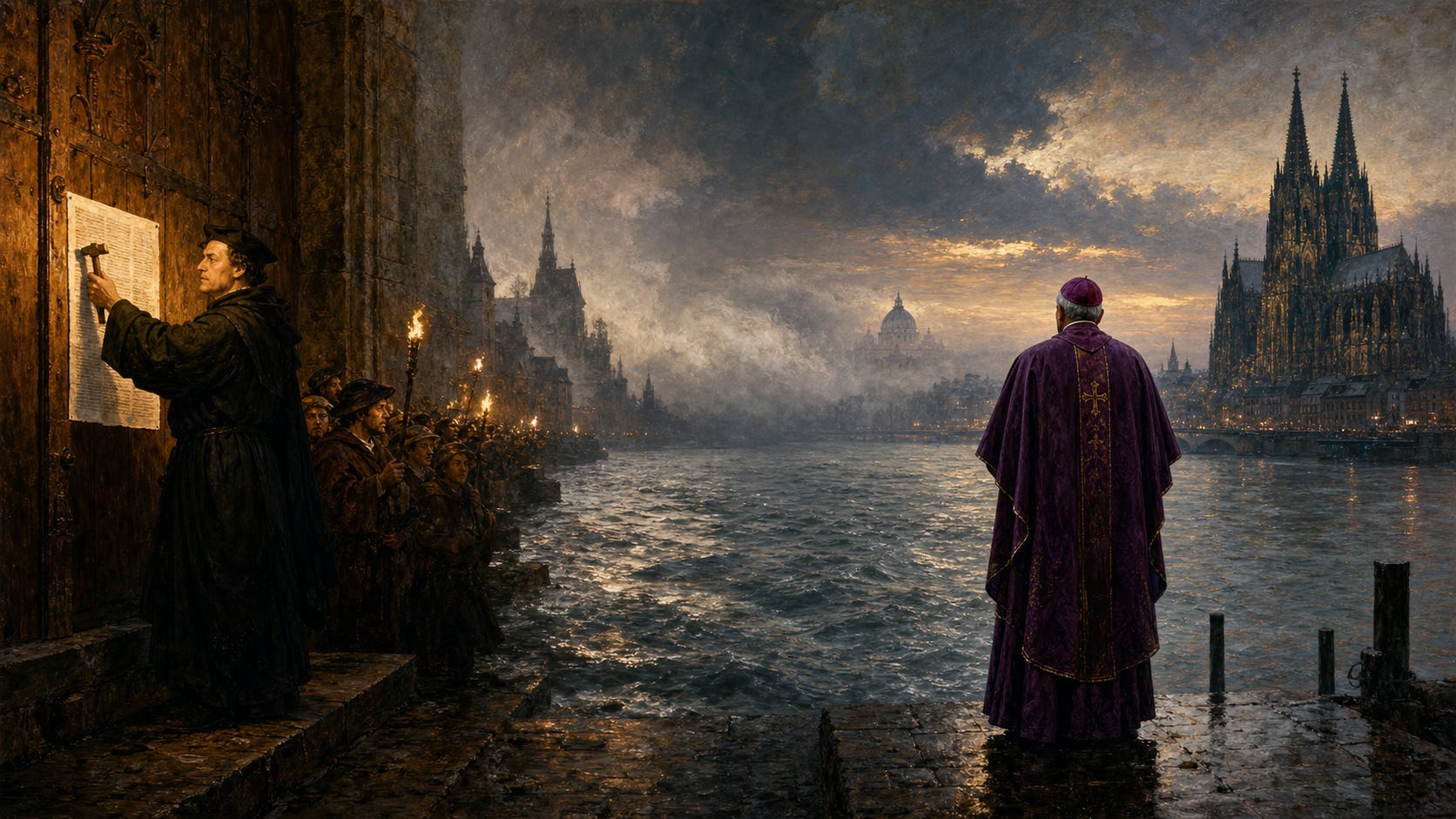
Five hundred years ago, a German monk nailed a list of complaints to a church door. That monk was Martin Luther. His complaints started a fight that split Christianity in half. The fight was called the Reformation.
We know that story!
But today, Germany is doing it again.
Not with a hammer and a door. This time it’s happening in meeting rooms, church conferences, and Vatican letters. But the question underneath it all is the exact same question Luther asked back then.
Who gets to decide what the Church believes?
That question is now sitting right in the middle of German Catholicism and the surrounding countries. And how it gets answered could change the Catholic Church for generations if not split the Church yet again.
How this all started
You have to go back to 2019 to understand where this began. Kind of.
But let’s stick with 2019 for now.
Germany’s Catholic Church was in larger crisis than in the 1960’s.
A massive abuse scandal had rocked the country. The German leadership would say people are leaving the Church by the thousands. Trust was gone. Something had to change.
But trust has been gone from the lay faithful since the 1970’s when things were sideways!
So most of the current German bishops, along with a lay group called the Central Committee of German Catholics, started something called the Synodal Way. The goal, at first, sounded reasonable:
Hold leaders accountable for abuse.
Take care of victims.
Be honest and transparent.
Remove clergy who covered things up.
Nobody serious disagrees with any of that. If your house is on fire, you put out the fire. That part of the story is not controversial.
But here’s the thing. The fire didn’t stay contained.
From fixing abuse to rewriting doctrine
Imagine you hire a contractor to fix a leaky roof. A few months later, you come home and he’s knocked down a wall, moved your kitchen, and told you the whole house needed a new floor plan.
That’s basically what happened with the Synodal Way. At least, this is a simple way to explain it.
What started as a plan to fix abuse and corruption turned into something much bigger. German bishops began pushing for changes on:
Same-sex blessings — formal church ceremonies to bless same-sex couples.
Sexual morality — rethinking Catholic teaching on sex, contraception, and cohabitation.
Women’s ordination — opening the priesthood, or at least the diaconate, to women
Priestly celibacy — making it optional instead of required
Church power — giving laypeople a permanent, formal share of decision-making power alongside bishops
Some of these are more serious than others. Whether priests should be allowed to marry is a question about Church discipline and tradition going back to the apostles. Popes have changed disciplinary rules before mainly outside of the Latin (western church).
That’s very different from asking whether the Church has the authority to ordain women as priests, or whether it can bless something the Church still teaches is not a marriage. Even Pope Francis—likely the most liberal Pope in some 500 years didnt approve of what the German Church was doing with its most controversial demands and direction.
One is a policy question. The other is a doctrine question. And Germany does not get to decide doctrine questions on its own.
Pope Francis wrote two letters one in 2019 cautioning them on their renewal plans and another in 2023 saying, “a permanent Synodal Council” threatens Church unity and the sacramental structure of the Catholic Church.
Again, Pope Francis was no conservative in whatever definition you would want to give to that label. Francis certainly was the most pastorally and institutionally progressive popes in the modern era beating out Pope John XXIII and Pope Paul VI. One would have to go back to maybe, Clement XIV but even then, nothing really compares to the Francis papacy for again, the last 500 years.
The bishops leading the charge
Now back to the German Bishops.
This isn’t some fringe group of angry priests. Some of the most powerful bishops in Germany are driving this.
Bishop Georg Bätzing of Limburg has been the main public face and defender of the Synodal Way for years. Cardinal Reinhard Marx, the Archbishop of Munich, has been one of its most influential supporters. Bishop Helmut Dieser of Aachen has provided much of the theological argument behind the push to change teaching on sexual morality.
These aren’t outsiders. These are men running major dioceses in one of the wealthiest, most influential Catholic countries on earth.
Not every German bishop agrees
Here’s something important. This isn’t a simple story of “Germany versus Rome.” It’s more complicated than that, and it’s more interesting than that.
There are German bishops fighting this from the inside.
Cardinal Rainer Woelki of Cologne pulled his archdiocese out of parts of the Synodal Way. Good for him and his flock
Bishop Rudolf Voderholzer of Regensburg has been one of the sharpest critics of the whole process. Bishop Stefan Oster of Passau has warned, again and again, that this path leads toward division, not unity.
So this isn’t progressive Germany against a stubborn Vatican. It’s a real argument happening inside German Catholicism itself, about what the word “reform” is actually supposed to mean.
Does reform mean fixing broken, sinful institutions while keeping the Church’s teaching intact? Or does reform mean changing the teaching itself?
Those are two very different things wearing the same word.
Why Rome is saying no
Put yourself in the pope’s shoes for a second.
You lead a Church with over a billion members, spread across every country on earth. If you let one wealthy, powerful country rewrite core teachings on its own, what happens next? Every other country with enough money and enough confidence starts doing the same thing. Pretty soon, “Catholic” doesn’t mean the same thing in Germany that it means in Poland, or the Philippines, or Nigeria.
That’s one of Rome’s real fears. Not stubbornness. Fragmentation.
Rome has been fairly clear about where the line sits. There are some things that tradition and scripture simply say no too.
Blessing a person is different from blessing a union. A priest praying with someone, wishing them well, treating them with dignity and love — that’s always been allowed, and it should be. But a formal ceremony that looks and functions like a wedding blessing for a relationship the Church still defines as outside of marriage? That’s a different thing entirely. That’s not pastoral care anymore. That’s a doctrinal statement which then is preaching a lie.
Rome has told Germany, more than once: you can care for people without rewriting what the Church teaches about them.
Why Germany matters more than other countries
Reform pressure like this isn’t only happening in Germany. Belgium, Switzerland, Austria, and parts of the Netherlands are dealing with similar pushes.
But Germany is different, and here’s why.
Germany has something almost no other Catholic country has: a church tax.
Every registered Catholic pays a portion of their income tax straight to the Church. That means the German Church has enormous money. Enormous staff. Enormous bureaucracy. Universities. Media outlets. Aid organizations spread across the globe.
Practically some might say, a small reform movement in a poor diocese is easy to ignore. A well-funded, well-organized, nationally coordinated movement backed by one of the richest churches on earth is much harder to brush aside. Especially when you have radicals inside the church pushing these reforms.
And now Germany wants to make it permanent. There’s a push for a standing National Synodal Conference — a body that would keep pushing this agenda forward long after the current crisis fades from headlines.
That’s the piece that should get your attention. This isn’t a temporary reaction to a scandal anymore. It’s becoming a permanent institution.
So — is this Luther all over again?
Here’s where you have to be careful. History doesn’t repeat itself perfectly, and it’s tempting to slap old labels on new events just because they rhyme.
Luther’s revolt became a total break. He rejected the authority of the pope completely. He was excommunicated in 1521. Lutheran churches became their own separate thing, with their own beliefs about the sacraments, the Bible, and salvation. That was a full and final split.
Germany’s bishops have not done that. Not one of them has renounced the pope. Not one has declared a separate German church. Formally, on paper, they are still Catholic, still in communion with Rome.
But look at what the two moments share:
Both started in Germany.
Both began with a real, legitimate grievance.
Both grew from a specific complaint into a much bigger fight over who holds authority.
Both were powered by Germany’s wealth and institutional strength.
Both raised the same underlying question: does the local church answer to Rome, or does it answer to itself?
Germany hasn’t crossed the line Luther crossed. But it is standing right at the edge of it, closer than most people outside the Church realize.
What you should take from this
The Catholic Church absolutely needs reform. Nobody with a conscience can look at the abuse crisis and say otherwise. Correctly, victims deserve justice. Cover-ups deserve exposure. Leaders who failed deserve consequences.
But you can fix a broken institution without tearing down the beliefs that built it in the first place. Real reform cleans the house. It doesn’t rebuild it into something new and call it by the old name.
That’s the real deception here!
That’s the choice standing in front of German Catholicism right now.
Will it help renew the Church from the inside? Or will it end up building a German Catholicism that keeps the name, keeps the buildings, keeps the title — but quietly stops answering to Rome and becomes a fraud?
Five hundred years after Luther, Germany is once again asking Rome’s oldest and most dangerous question: who gets to decide what the Church believes?
The German Church hasn’t crossed the Rubicon (so to speak) yet.
But it’s standing right on the bank, looking across.
Pray for the faithful German Catholics who are trying to keep their church intact and most importantly, keep fighting the good fight.
~ David


