MOJO Academy Book Brief #40--Dreamland: The True Tale of America's Opiate Epidemic
MOJO Academy Book Brief
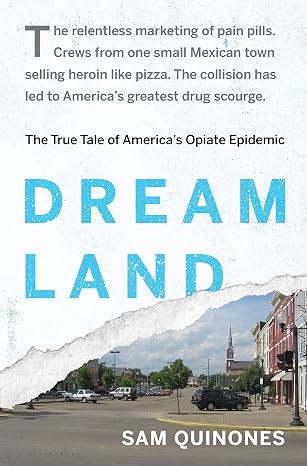
Book Title: Dreamland: The True Tale of America’s Opiate Epidemic
Author: Sam Quinones
Publishing Year: 2015
Number of Pages: 384
Audible Time: Approximately 15 hours
Brief Summary
This is one of the top ten books I have ever read in my entire life. Without question!
Coming back from Washington, D.C., in the late 1999, I was calling on medical service providers for the next roughly decade, and all of this was happening around me. I couldn’t believe it. I never saw anything that look out of the ordinary. I was calling on places in southern Ohio, Portsmouth, Ohio, West Virginia and Eastern KY, all of which, was the epicenter described in the book. My eyes have really been opened up by this profound and often sad and solemn tale.
Sam Quinones is a celebrated journalist, a longtime reporter for the Los Angeles Times, known for investigative work that shines a hard light on issues most writers are too comfortable to touch. He has spent his career reporting on immigration and on the opioid epidemic. His follow-up book, The Least of Us, picks up where this one leaves off.
Dreamland tells two stories that collided and became one American tragedy. One story is a small town in Xalisco, Mexico, where young men built a heroin delivery system that worked like a pizza chain, complete with drivers, territories, and customer service. The other story is Purdue Pharma, a pharmaceutical company that convinced American doctors that a powerful opioid could be prescribed like aspirin, with almost no risk of addiction.
Those two stories met in small-town and rural America, and the result was a body count most of us are still refusing to look at directly.
Two Important Quotes
1. “Most drugs are easily reduced to water-soluble glucose in the human body, which then expels them. Alone in nature, the morphine molecule rebelled. It resisted being turned into glucose, and it stayed in the body. ‘We still can’t explain why this happens. It just doesn’t follow the rules. Every other drug in the world, thousands of them, follows this rule. Morphine doesn’t. It really is almost like someone designed it that way, diabolically.’”
Sit with that for a moment. Every other drug on earth, thousands of them, gets broken down and flushed out. Morphine refuses.
It is almost like it was designed to trap you, and once you understand that one fact about the molecule itself, everything else in this book makes a terrible kind of sense.
2. “By the end of the 2000s, it was already common for people to go from abusing Oxycontin to a heroin habit. Purdue Pharma recognized this and, in 2010, reformulated Oxycontin with an abuse deterrent, making the drug harder to deconstruct and inject. The intent was to make Oxy less abusable. It did. Had the company done this in 1996, our story might have been different, but now there was a swollen population of Oxycontin addicts nationwide. Without Oxy, they flocked to heroin in even greater numbers.”
Read that timeline again. Purdue Pharma knew, and waited fourteen years to fix it.
Fourteen years of addiction built up before the company finally closed the door, and by then it did not stop anyone. It only pushed a swollen population of addicts straight into the arms of the Xalisco Boys.
My Nuggets of Wisdom!
I read this book back in 2019, and I have wanted to write this review ever since. Some books stay with you. This one never left.
Here comes our most important nugget, and it comes straight from a mother Quinones interviewed in the book.
When your kid is dying from a brain tumor or leukemia, the whole community shows up. They bring casseroles. They pray for you. They send you cards. When your kid is on heroin, you don’t hear from anybody until they die. Then everybody comes, and they don’t know what to say.
That is the whole tragedy in one paragraph. Cancer gets casseroles. Addiction gets silence, until the funeral.
Quinones lays out three waves, and every American should know them:
Wave one, the 1990s — doctors prescribing opioids like candy, told by drug companies there was almost no risk
Wave two, 2001 to 2013 — the pivot to black tar heroin, and overdose deaths climbing sharply
Wave three, 2013 to today — synthetic fentanyl, and a death toll that now runs into the hundreds of thousands
Like I mentioned earlier, I spent years calling on medical service providers and durable medical equipment companies in Portsmouth, Ohio. I drove those same roads regularly, into southern Ohio and Huntington, West Virginia. Looking back now, I believe I was working within walking distance of what was, in fact, a pill mill, and I never knew it.
Nothing ever looked out of the ordinary.
Everybody shares blame here. Purdue Pharma, for building a product and a marketing campaign around a lie. The Xalisco Boys, for turning heroin distribution into a customer-service business. And government at the state, local, and federal level, for looking away for far too long while people kept dying.
I am honest enough to say I do not have the clean answer. The war on drugs has not solved this. Legalization has not solved this either. Every time we reach for the easy fix, we overcorrect and create a new problem. What I do believe is that these are human beings in desperate straits, and we owe them a system that treats them humanely, not a slogan from either side of the aisle.
Final Recommendation
Read this book. It will open your eyes.
Read it if you have ever driven through small-town America and wondered what happened to it. Read it if you have ever judged a family dealing with addiction without understanding the forces stacked against them. And read it if, like me, you thought you understood this crisis until you actually sat with the whole story.
If you want to dive deeper, we have a premium product, our Mojo Academy review, which is an eight-page PDF that does a deep dive into this book. Roughly about a 40-minute read. You can sign up for that premium product and become a monthly member at our main website here, then in the top right, through the sign-up process.
If You Liked This Book, You Might Like These
The Least of Us by Sam Quinones – Quinones’s own follow-up, picking up the opioid and fentanyl crisis where Dreamland leaves off.
Deep Work by Cal Newport – Not an obvious pairing at first glance, but Newport’s argument about a culture built for shallow distraction says something true about the same country Quinones is writing about.
Overrun by Todd Bensman – Bensman’s reporting on our broken southern border pairs directly with Quinones’s Xalisco Boys, showing how easily networks built for smuggling people can just as easily be built for smuggling heroin.
Keep fighting the good fight.


