MOJO Academy Book Brief #42--The Age of Reagan, Vol 1
MOJO Academy Book Brief
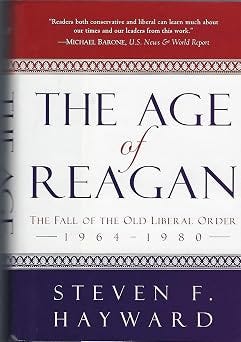
Book Title: The Age of Reagan: The Fall of the Old Liberal Order, 1964–1980
Author: Steven F. Hayward
Publishing Year: 2001
Number of Pages: 811
Audible Time: No audible boooo!
Brief Summary
I crushed this book in two and a half weeks reading it on Kindle in the summer of 2024.
Yes, I read the old school way. ha! Hard to believe I know!
That is fast for a book this size, and it should tell you something about how it grabbed me and kept me engaged from the start and kept turning the pages.
Steven Hayward set out to write more than a Reagan biography. He set out to write the conservative account of the fifteen years that made Reagan possible.
The book runs from Lyndon Johnson’s landslide victory over Barry Goldwater in 1964, through the collapse of the Great Society, the Vietnam War, Watergate, Gerald Ford’s near miss, and Jimmy Carter’s malaise, all the way to Reagan’s election in 1980.
This is Volume One of Hayward’s two-volume history.
Volume Two, The Age of Reagan: The Conservative Counterrevolution, 1980–1989, picks up the story at Reagan’s inauguration and carries it through the presidency itself. We’ll surely cover that volume in a future brief.
Hayward’s argument is simple because it is devastating to the liberal version of events and thank God because it is finally refreshing to hear the other side.
Liberalism did not fall because conservatives out-argued it in a single moment.
It fell because it kept failing, decade after decade, in ways the country could see and feel. Reagan did not create the opening. He walked through a door that liberalism had already broken.
My immediate reaction was relief. Again, thank God someone has finally written about this period.
I have some reservations about some opinions Steven has about certain events but more on that later.
For now, here was a conservative author looking at the last 60 years of U.S. history through a conservative lens, and things and events finally started to make sense.
I had always been told the liberal side of the story, no matter where you or I looked. In college, in political science classes, in bookstores, in libraries. Everywhere a conservative looked was the other side of the story. The liberal side.
Now I was finally getting the conservative worldview of that same stretch of history with deep insight and that is the gem of this book!
That is what convinced me this book was worth featuring as MOJO Book Brief.
In summary, the whole book is really looking at modern America for the last 60 years through a vastly different lens, and that interpretation matters.
Two Important Quotes
1. “Even the greatest and most successful politicians typically end their careers with a large note of failure hanging over their head. Lincoln died with the question mark of reconciliation and reconstruction; Woodrow Wilson left office amidst the failure of the League of Nations Treaty; FDR died; Churchill left office with World War II, but with the seeds of the Cold War clearly germinating; Truman left office amidst the debacle of the Korean War; Reagan left office with the Cold War still going and with astronomical budget deficits that threatened the nation’s well-being for as far as the eye could see—a seemingly long-term legacy of failure.
Yet within a breathtakingly short time, by political standards, the Cold War was over, and the nation’s biggest fiscal problem was what to do with its soaring budget surpluses. Both events lent a large measure of vindication to Reagan’s designs.”
One quick note on that list: Wilson is an odd inclusion among the greats. Hayward himself has ranked Wilson near the bottom of American presidents elsewhere in many of his works.
Regardless, this quote puts Reagan in the company of Lincoln, FDR, and Churchill, and that placement is deliberate.
Every one of those men left office under a cloud. History waited them out and then handed down its verdict.
Reagan’s verdict came fast. The Cold War ended.
The deficits turned to surpluses (the balanced budgets of the Gingrich-Clinton years, built on the growth Reagan’s policies had set in motion). Hayward is telling you that the men who called Reagan a failure in 1988 did not have to wait long to be proven wrong. And yes some of us are STILL spiking that football.
2. “Yet here we encounter a striking paradox that lies at the heart of the political dynamic of America today. Since 1964, America has increasingly embraced political conservatism and rejected political liberalism, yet at the same time Americans have become more conservative politically. They have become more liberal socially and culturally... The tolerance of, if not approval for, abortion, homosexuality, illegitimacy, single motherhood, casual sex, pornography, coarsening language, degraded educational standards, and public disorderliness—to name a few—grew alongside public disapproval for big government, even though Reagan and the conservative movement crusaded against both phenomena. Eight years of Ronald Reagan hardly slowed the advance of political correctness. Shelby Steele wrote, ‘He won the Cold War but not the culture war.’”
This is the quote that stopped me cold. Reagan won the argument over government.
He lost the argument over culture.
That split has only widened since Hayward wrote this in 2001, and it explains most of what still divides the country today.
This is why I consider this book a foundational pillar for understanding modern U.S. history, if you are a conservative. You cannot make sense of where we are now without understanding how we got here.
My Nuggets of Wisdom!
Here is what stuck with me most. Reagan was the first U.S. president to really push back against the FDR liberal onslaught beginning in 1932. Donald Trump, in his second term, has begun to do the same thing.
Two presidents, Reagan and Trump, four decades apart, fighting the same entrenched bureaucratic and adminstrative order
Both facing the same media hostility and the same predictions of failure
Both vindicated faster than their critics expected
I have spent time in Washington, D.C. in the late 90’s, and since, I have called on small businesses across the Midwest.
In both settings you meet the same two Americas Hayward describes: the one that trusts government to fix everything, and the one that has watched government fail to fix anything. This book explains how that second America found its voice in 1964 and did not lose it.
Fans of MOJO’s brief on A Revolution of Common Sense by Scott Jennings will see the throughline here immediately.
Jennings writes about Trump storming Washington in real time. Hayward writes about Reagan doing the same thing forty years earlier. Put the two books side by side and you are watching the same movie with a different lead actor.
Ronald Reagan would absolutely approve of this book. A man does not get a fair hearing from history very often, and this is Reagan getting one.
There are many Reagan biographies but this is the most fair and most well explained.
Final Recommendation
This book is for anyone who has ever felt like they were only getting half the story of modern America. Again, for the growing number of conservatives and Republicans this one is for you.
It is also for the history buff who wants the footnotes to back up the argument. It is for the political junkie who wants to understand why the culture war never ended even after the Cold War did.
For any liberal critics of this book, I would say this: you have had over a hundred years to continually tell your liberal side of the story. Now the conservatives should have the right to tell their side of the story and see who ends up closer to the truth.
Read this book. Then decide for yourself.
If You Liked This Book, You Might Like These
A Revolution of Common Sense by Scott Jennings – Jennings picks up the same fight Hayward chronicles, four decades later, with Trump in Reagan’s role.
American Marxism by Mark Levin – The great one Mark Levin lays out exactly what the “old liberal order” Hayward describes eventually became.
The Age of Reagan, Vol. 2 by Steven Hayward – Hayward’s own sequel, picking up the story at Reagan’s inauguration and carrying it through the presidency itself.
Before you go, a quick note.
On some of these books we feature as a MOJO Book Brief, our MOJO Academy members get a six to eight-page deep-dive PDF with more history, more analysis, more quotes, and more connections that help tell the fuller story.
Check out our listing of books in the MOJO Academy over at Team MOJO Academy website, our title list is over 50 now and growing (yea buddy), and see if you wish to become a monthly member. We would love to have ya!
as always
Keep fighting the good fight.


