MOJO Academy Book Brief #45--Crisis of Islam
MOJO Academy Book Brief
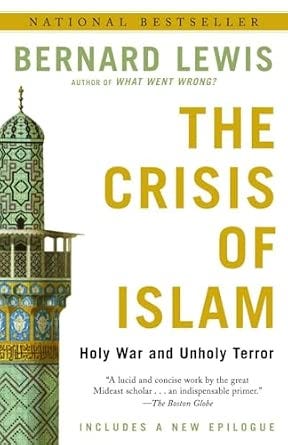
Book Title: Crisis of Islam: Holy War and Unholy Terror
Author: Bernard Lewis
Publishing Year: 2003
Number of Pages: 224
Audible Time: Just under 5 hours (easy peazy)
Brief Summary
I discovered Bernard Lewis in college, when a professor assigned his book Islam and the West.
That one book turned into a decades-long habit of reading everything Lewis wrote, and Crisis of Islam is the sharpest, most essential entry in that body of work.
Written in 2003, in the shadow of 9/11, Crisis of Islam was Bernard Lewis trying to explain something most of the West still refused to look at directly…me included.
Lewis was not a pundit.
He was one of the great Middle East historians of the twentieth century, and he spent his career trying to paint reality for us — clearly, without flinching, and without the softening language that so much of academia and media prefers.
This book traces the fault line running through the Islamic world — from the golden age of Islamic civilization, through centuries of decline relative to the West, to the rise of two very different but equally dangerous radical responses to that decline. One is Shia. One is Sunni. Lewis shows you both, names both, and refuses to pretend either one is the lesser evil.
Now, more than twenty years after this book was published, we are watching its warnings play out in real time — Iran racing toward a nuclear bomb through the 2010s and into the 2020s, and Hamas launching its own version of 9/11 against Israel on October 7, 2023.
Lewis saw the shape of this coming.
He just didn’t get to see how right he was. Lewis passed away in May 2018. He lived to be 101 years old!
Two Important Quotes
1. “In time it goes back more than fourteen centuries, to the advent and mission of the Prophet Muhammad in Arabia in the seventh century C.E. and the creation under him of the Islamic community and state. In the period which European historians see as a dark interlude between the decline of ancient civilization — Greece and Rome — and the rise of modern civilization — Europe, Islam was the leading civilization in the world, marked as such by its great and powerful kingdoms, its rich and varied industry and commerce, its original and creative sciences and letters. Islam, far more than Christendom, was the intermediate stage between the ancient East and the modern West, to which it contributed significantly. But during the past three centuries, the Islamic world has lost its dominance and its leadership, and has fallen behind both the modern West and the rapidly modernizing Orient. This widening gap poses increasingly acute problems, both practical and emotional, for which the rulers, thinkers, and rebels of Islam have not yet found effective answers.”
Did you catch that? Islam was —at one time—the leading civilization on earth. Not a footnote to Europe’s story — the main event, in the Middle East and for centuries, while the West was still finding its footing, the world’s intellectual center.
That’s the piece so many people miss.
You cannot understand the crisis Lewis is describing unless you first understand the greatness that came before it.
A civilization that once led the world in science, commerce, and letters does not quietly accept falling behind.
It grieves.
Then, It rages.
And in the worst cases, it produces men who believe the only way back to greatness is through violence.
2. “The rejection of modernity in favor of a return to the sacred past has a varied and ramified history in the region and has given rise to a number of movements. The most important of these was undoubtedly that known, after its founder, as Wahhabism. Muhammad ibn ‘Abd al-Wahhab (1703–1792) was a theologian from the Najd area of Arabia, ruled by local sheikhs of the House of Saud. In 1744 he launched a campaign of purification and renewal. His declared aim was to return to the pure and authentic Islam of the Founder, removing and where necessary destroying all the later accretions and distortions. The Wahhabi cause was embraced by the Saudi rulers of Najd, who promoted it, for a while successfully, by force of arms.”
Now that’s agonizing history, and it’s history most Americans have never been taught. A theologian in the middle of the Arabian desert, nearly three hundred years ago, launches a purification campaign — and the fingerprints of that campaign are still on the front page today.
You see, Wahhabism didn’t stay in the Najd.
It became the theological bloodstream running through Sunni radicalism for the next two and a half centuries, right up through bin Laden and beyond.
Lewis is showing you the root, not just the branch. That’s what a real historian does.
My Nuggets of Wisdom!
Lewis became one of the intellectual anchors of how I understand the Middle East, and this book is the sharpest, most compact version of everything he spent his career trying to teach us.
We would do well to read him and to understand better, the roots of rage.
Here’s the nugget Lewis returns to again and again: the 1979 Iranian Revolution and the rise of Sunni jihadism under bin Laden are not two separate problems.
They are both wings of the same devil.
Did you catch that? Both wings of the same devil.
Don’t pass over this!
The Shia radicals under Khomeini and the Sunni radicals under bin Laden hate each other.
But both emerged from the same wound — a civilization that fell behind and produced men who chose holy war over honest reckoning with why.
Here’s what happened after the Iranian Revolution succeeded, and it’s worth knowing.
Khomeini didn’t govern alongside the leftists and the communists who helped bring him to power — he purged them, and the numbers are staggering.
Between 1980 and 1988, tens of thousands of leftist organizers, students, and dissidents were arrested, and thousands were executed, culminating in a 1988 fatwa that unleashed “death committees” on Iran’s remaining political prisoners.
That’s your nugget of wisdom, the revolutionaries who helped Khomeini seize power were the first people he turned on once he no longer needed them. As we know from so many revolutions of the left, they always eat their own! Think of the French, Russian and Chinese Revolutions….pure carnage after the revolution was complete!
I believe we’re watching a similar coalition forming inside the Democratic Party today — the radical Democratic Socialists winning primaries, marching alongside establishment Democrats the same way Iran’s leftists once marched alongside the mullahs, right up until they weren’t needed anymore.
Democrats who don’t push back against the radicals in their own party will watch that party get taken over and sidelined, just as George McGovern’s 1972 run, once considered the high-water mark of the American left, now looks like the JV squad next to what’s rising today.
I believe Bernard Lewis would stand up and applaud the moment the West finally started coming to terms with the reality he spent his life describing — again, he passed away in 2018, before he could see how right he was, and that’s agonizing.
Lewis was great in describing for the Westerner why some radicals of Islam are hell bent going on Jihad.
But that is only one side of this holy terror.
The other side the Muslim brotherhood which advocates, gradualism, patience and immigration weaponization to convert the “apostates” or unbelievers for all non-believers of Islam. This is another branch rising called Islamism, which Lewis didnt touch on but which we in the West should be prepared to confront.
Final Recommendation
This book is for the political junkie who wants the historical roots underneath today’s headlines, not just another hot take.
It’s for the history buff who wants to understand where radical Islam actually comes from — not the cartoon version, the real one. And frankly, it’s for every American who wants to understand why October 7, 2023 — Israel’s 9/11 — didn’t come out of nowhere.
It had roots in rage.
Bernard Lewis was one of the smartest writers in the Western world on the subject of Islam, and he left behind many, many books. Crisis of Islam is just one of them, and it won’t be the last one we cover here at MOJO Academy.
Read this to understand the Western crisis, and read it to understand something else: the United States has largely never had to a fight a fusion of radical socialists and Islamic radicals (a fusion now called the Red-Green alliance) on our own soil before.
That’s about to change, and Lewis’s book on Iran’s 1979 revolution and the Crisis of Islam is the clearest warning we have of what happens when a coalition of convenience meets a radical movement that intends to rule alone.
As always, keep fighting the good fight.
If You Liked This Book, You Might Like These
Suicide of a Nation by Matt Goodwin – Goodwin’s diagnosis of the UK’s civilization losing its own internal cohesion pairs naturally with Lewis’s diagnosis of a civilization that fell behind and turned to rage. Read them together and you start to see the same disease wearing two different masks — one Western, one Islamic. One taking over the other.
What Went Wrong? by Bernard Lewis – Lewis’s companion volume, asking the deeper question underneath Crisis of Islam: why did the Islamic world, once the leading civilization on earth, fall behind the West? If this brief hooked you, that book is the natural next step.
Invisible Coup by Peter Schweizer – For readers who want to see the domestic side of this coin: how power gets quietly seized and consolidated at home, the same patient, gradualist playbook Lewis warns about when he describes movements that use time, patience, and infiltration rather than open war. Especially in the weaponization of Immigration.


