MOJO Academy Book Brief #51--The Impending Crisis
MOJO Academy Book Brief
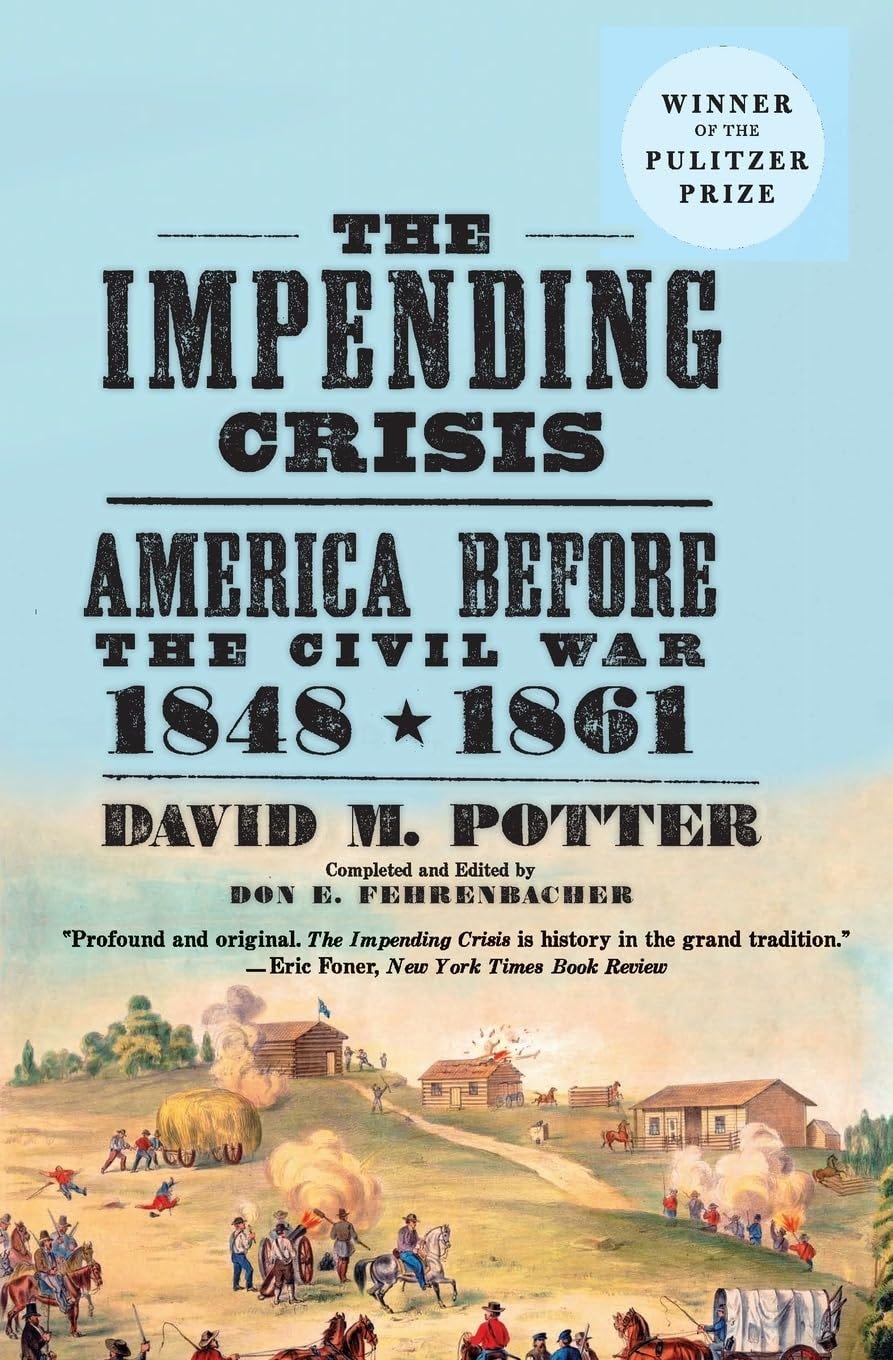
Book Title: The Impending Crisis: America Before the Civil War, 1848–1861
Author: David M. Potter (completed and edited by Don E. Fehrenbacher)
Publishing Year: 1976
Number of Pages: 638
Audible Time: 22 hours, 41 minutes (yup a long one but well worth it)
Brief Summary
I didn’t find this book on my own. A Gettysburg battlefield guide put it in my hands.
And ironically, this past week, I was back at the Gettysburg battlefield. I went to see the visitor center, the expanded bookstore, and the new grounds for the presentation of the Cyclorama. That’s an enormous 360-degree painting, with foreground, lighting, and sound, that puts you right in the middle of Pickett’s Charge on July 3, 1863.
I say new, but the building opened back in September 2008, and I hadn’t been back to the battlefield since.
This was my fifth trip to the national military park, and I’d encourage anyone to go. It’s my belief that to really understand the United States, you have to understand its Civil War. Plus, I ended my visit with seeing the location of the Gettysburg address delivered by Abraham Lincoln which is worth its visit right there. Perhaps the greatest speech ever given on U.S. soil.
Now to understand the US Civil war completely, you have to start with several books. One of the most important is this one, we are reviewing today, David Potter’s The Impending Crisis.
That first battlefield guide told me it was the most important book for understanding the Civil War for many reasons. His reasons although were quite simple:
you can’t understand the war until you understand the years leading up to it
why men made the decisions they made, and
the context of those decisions makes all the difference.
Boy, does this book ever deliver on all those points.
So thank you to that guide. And frankly, each time I’ve been back, I’ve asked other guides, and they’ve confirmed it. This is one of the most important books to read on the years before the Civil War.
David Potter covers the 13 years between the end of the Mexican War and the firing on Fort Sumter. He walks us through the Compromise of 1850, the Kansas-Nebraska Act, Dred Scott, Bleeding Kansas, John Brown’s raid, and the breakup of the Democratic Party. Potter died before he finished it, and his colleague Don Fehrenbacher thankfully completed the work.
Then it won the Pulitzer Prize in 1977.
This is also where I first learned about the Fire-Eaters, the ultra-radicals of the South who pushed their region into war. That discovery grew into the MOJO Academy series “America’s Story: The Rise and Fall of the Fire Eaters.” I’ve returned to this book on several MOJO Minute episodes, in particular 138, 402, and 440.
If anybody asks me where to start on the Civil War, this book is my answer every time.
Two Important Quotes
“For 10 years, the Union had witnessed a constant succession of crises. Always, these ended in some kind of victory for the South, each of which left the South with an empty prize and left the Union in a weaker condition than before. In 1850, the South had paid a dear price for the Fugitive Slave Act. In 1853, it squandered some of its influence to procure the Ostend Manifesto. In 1854, it sacrificed the bipartisan ascendancy of the Democratic Party for the sake of Kansas and Nebraska. In 1857, it prepared to pay whatever the cost might be for upholding the Dred Scott decision. In 1858, it sacrificed what was left of the Northern democracy in the vain attempt to force the adoption of the Lecompton Constitution.
Such were the trophies of victory. Not one of them added anything to the area, the strength, the influence, or even the security of the Southern system. Yet each had cost the South a high price, both in alienating the public opinion of the nation and in weakening the one great bulwark of sectionalism, the Democratic Party, which alone stood between the South and sectional domination by the Republicans.”
This is the whole decade in one paragraph.
The South kept winning, and every win made it weaker. Each victory pushed Northern opinion further away and chipped at the one national party that held the country together.
Winning the fight in front of you means nothing if it costs you the ground you stand on. That’s a lesson for any movement, in any century.
“They wanted to split the Democratic Party in order to ensure a Republican victory, which they believed would precipitate the South into secession. The importance of this factor of conspiracy to bring about disunion is difficult to evaluate, partly because it was almost certainly exaggerated by the political opponents of the fire-eaters at the time and by pro-Northern historians later. But it was unquestionably an element in the situation.
At Charleston, Southern radicals did not hesitate to declaim their willingness to quit either a party or a federal union which denied them their rights under the Constitution. On the day of the disruption at Charleston, a delegate from Mississippi made an impassioned and thrilling speech in which he declared, with piercing emphasis, that in less than 60 days there would be a united South. At this declaration, there was the most enthusiastic shouting yet heard in the convention.
That evening, the Southerners held an immense mass meeting at which there was a ‘Fourth of July feeling, a jubilee.’ No such occasion would have been complete without some eloquence from William L. Yancey, and the Alabama orator told the crowd that ‘perhaps even now the pen of the historian was nibbed to write the story of a new revolution.’”
Here are the Fire-Eaters in their own element.
They didn’t stumble into disunion. They wanted the Democratic Party broken, because a broken party meant a Republican president, and a Republican president meant secession.
And the crowd cheered. That’s the part that should chill every American reader.
My Nuggets of Wisdom!
Potter shows that war was not inevitable. It was built, one fatal decision at a time, by men who could have chosen differently.
What stood out to me most:
Small radical factions can steer an entire region when the moderates go quiet.
Breaking the institutions that bind a nation together is often the radicals’ goal, not a side effect.
Short-term political wins can hide long-term losses until it’s too late.
Here’s my warning. Don’t think for a second that the kind of radicals who pushed the South into civil war can’t push America into a second one.
It has happened before in other nations. The English fought more than one civil war of their own.
The pattern repeats. Radicals push, institutions crack, and ordinary people pay the bill.
Final Recommendation
If you want to understand the Civil War, start here.
Not with the battles, but with the 13 years that made the battles possible. Before battles, there are the arguments!
Potter is fair to every side, and he takes the people of the time seriously.
You come away knowing why each decision was made, and why each one made the next crisis worse.
The folks who know how a republic falls are the ones best equipped to keep it standing.
If You Liked This Book, You Might Like These
Myth of the Lost Cause by Edward Bonekemper — the honest answer to why the South really seceded.
The Storm Before the Storm by Mike Duncan— shows Rome walking the same road, as radicals on both sides broke the norms that held the Republic together.
Gettysburg: The Last Invasion by Allen Guelzo — see the war that Potter’s decade produced, at its turning point.
For now, Keep fighting the good fight.


