MOJO Academy Book Brief #50--Sword and Scimitar
MOJO Academy Book Brief
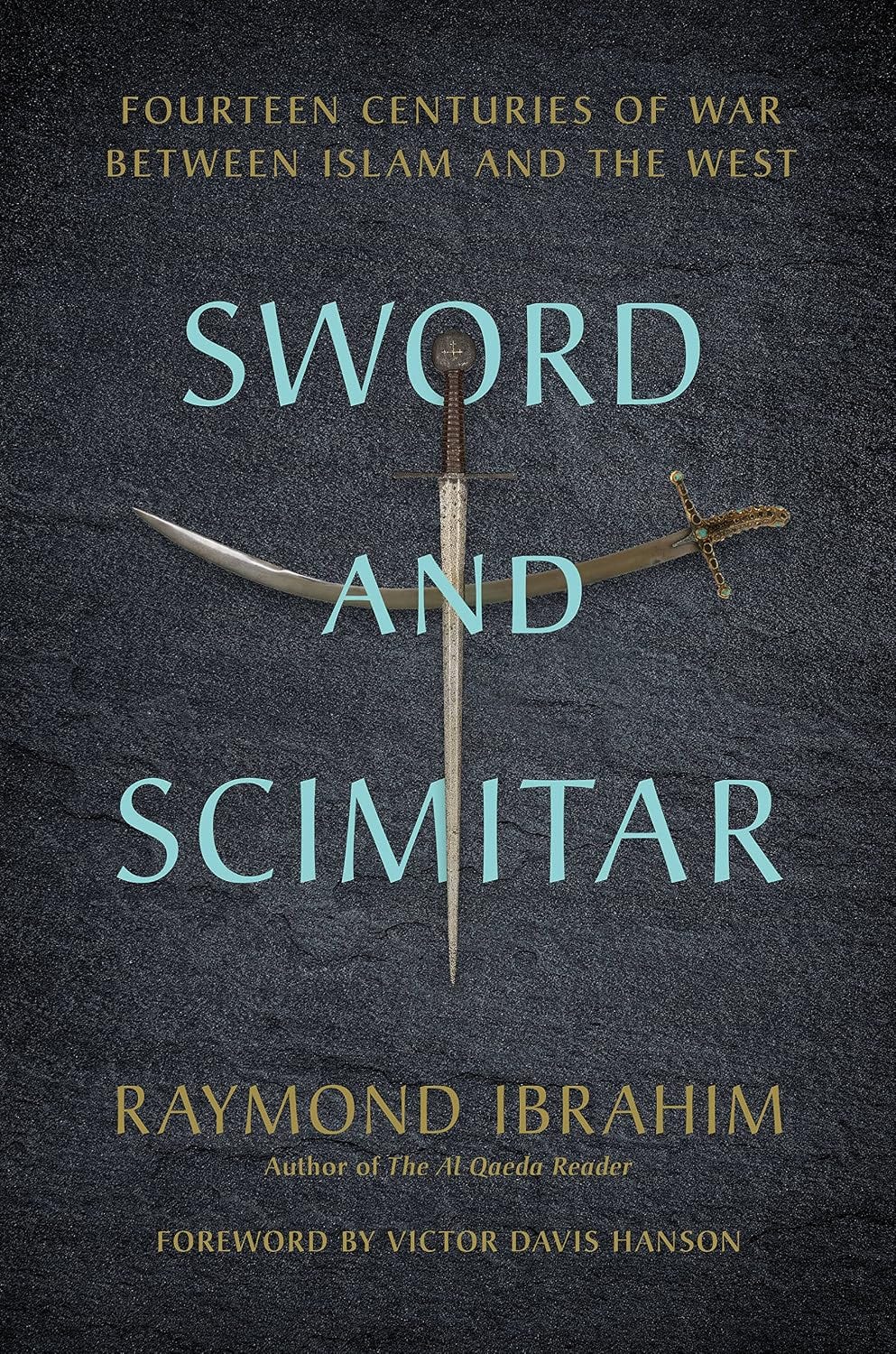
Book Title: Sword and Scimitar: Fourteen Centuries of War between Islam and the West
Author: Raymond Ibrahim
Publishing Year: 2018
Number of Pages: 352
Audible Time: 14 hours, 2 minutes
Brief Summary
I began reading this book after a lengthy search, following 25 years of thinking Islam was a religion of peace. I now had to confront the reality that perhaps it was not. My thinking changed dramatically over those 25 years, but especially on October 7, 2023.
Islam and the West have been at war, on and off, for almost fourteen hundred years. That is the argument of this book, and Raymond Ibrahim makes it battle by battle.
Ibrahim is a scholar of the Middle East and a former Arabic linguist at the Library of Congress. He builds the book around eight landmark battles, from Yarmuk in 636 to the Siege of Vienna in 1683. Each one was a turning point, and each one could have gone the other way.
What sets this book apart is its sources. Ibrahim quotes the men who fought these wars, drawing much of the material from Arabic and Greek records that rarely reach English readers. You hear both sides explain, in their own words, why they were fighting.
The foreword is by Victor Davis Hanson. When one of the best military historians alive signs the front of your book, that tells you something.
Two Important Quotes
“Once upon a time, the Islamic world was a superpower and its jihad an irresistible force to be reckoned with. Over two centuries ago, however, a rising Europe—which had experienced more than one millennium of Muslim conquests and atrocities—eclipsed and defanged Islam. As Muhammad’s civilization retreated into obscurity, the post-Christian West slowly came into being. Islam did not change, but the West did: Muslims still venerate their heritage and religion—which commands jihad against infidels—whereas the West has learned to despise its heritage and religion, causing it to become an unwitting ally of the jihad.”
This is a crucial point of the book.
Notice what Ibrahim is saying. The danger to the West was never just the strength of its enemy. The real danger is a West that no longer believes in itself.
This is unlike the thousand years of Christendom, from the 7th to the 17th centuries. It is also unlike the experience of the Russian people, who have battled Islam’s incursions into their territories for most of their history.
As for Europe, that is exactly where Douglas Murray picks up in The Strange Death of Europe. Murray shows you a Europe that has lost faith in its own story. Ibrahim shows you the story Europe forgot.
A civilization that despises its own heritage will not fight for it. And a civilization that will not fight for itself does not last long.
Again, this is unlike the Europe of Christendom, which won significant battles at Tours in 732 and Vienna in 1683.
This is the main thrust of the book. Ibrahim covers eight major battles to tell the 1,400-year story of conflict between Muslims and Christians:
Four Muslim victories.
Four Christian victories.
“Muhammad upheld the dichotomy of tribalism, but by prioritizing fellow Muslims over blood relatives. Thus the umma—the Islamic ‘Super-Tribe’ that transcends racial, national, and linguistic barriers—was born; and its natural enemy remained everyone outside it.”
Here we understand much better why the conquests kept coming. The old Arab tribes fought each other over blood and land. Muhammad took that same us-versus-them instinct and pointed it outward.
The result was a loyalty bigger than family, bigger than nation, bigger than language. That made the early Muslim armies a force no tribe had ever been.
It also drew a hard line around the world. Inside the line, brothers. Outside it, the enemy—or “infidels,” in their words.
Once you see that, the fourteen centuries of war in this book stop looking random. They start looking like a pattern.
My Nuggets of Wisdom!
The first thing this book does is fix the order of events.
Most Americans were taught that the Crusades started the fight between Islam and the West. Ibrahim shows why that story is rubbish and gets things backward. By the time Pope Urban II called the First Crusade in 1095, Muslim armies had been taking Christian lands for more than four hundred years.
Here is what stood out to me most:
Syria, Egypt, and North Africa were Christian for centuries before they were conquered.
Most of Spain had already fallen.
The Byzantine army had just been destroyed at Manzikert in 1071.
The Crusades were an answer, not the opening shot.
We will cover the Crusades in more depth in future Book Briefs on this subject.
The second lesson is that Western civilization was never guaranteed.
At Constantinople in 717, at Tours in 732, and at Vienna in 1683, everything came down to whether a small number of men would stand their ground. At Vienna, the Ottoman army surrounded the city for two months. Then, on September 12, 1683, Jan Sobieski’s Polish cavalry charged down the hill and broke the siege.
As a Catholic, I can’t read that story without thinking about how many people across Europe were praying for that city. Sobieski is said to have sent word to the pope afterward: “I came, I saw, God conquered.” It is the inverse of Caesar’s famous line, “I came, I saw, I conquered.”
Most importantly, we did not get Western civilization for free. Somebody paid for it, more than once.
The book does have a blind spot worth naming, but it is not Ibrahim’s fault.
This book is built around battles, which leaves out the nuances of treaties, trade, and some notable occasions when Christians did great damage to each other, such as the sack of Constantinople in 1204. Yes, that was blue-on-blue fighting. Terrible, but true.
Ibrahim is writing about two civilizations and the ideas behind their wars, not about the family down the street.
Still, the book as a whole—and its core argument—holds up. The battles happened. The order of events is what it is.
Final Recommendation
Read this book, then hand it to a young person you care about. Most of them don’t know Christian history—or, for that matter, much of real American history.
Ask them first if they’ve heard of the Battle of Tours or the Siege of Vienna. If they haven’t, you’ve found the problem this book solves. A people who don’t know their own history can’t defend it.
If You Liked This Book, You Might Like These
The Crisis of Islam by Bernard Lewis—a shorter, scholarly look at why the modern Muslim world sees the West the way it does.
The Strange Death of Europe by Douglas Murray—the modern sequel to Ibrahim’s history: a Europe that forgot what it once defended.
An Army at Dawn by Rick Atkinson—another story of ordinary men who had to learn to fight before they could win.
Keep fighting the good fight.


