MOJO Academy Book Brief #43---The Hundred-Year Marathon
MOJO Academy Book Brief
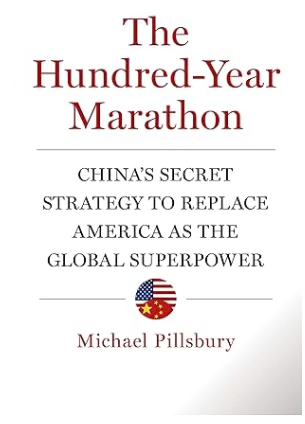
Book Title: The Hundred-Year Marathon: China’s Secret Strategy to Replace America as the Global Superpower
Author: Michael Pillsbury
Publishing Year: 2015
Number of Pages: 336
Audible Time: 9 hours 28 minutes
Brief Summary
Michael Pillsbury’s *The Hundred-Year Marathon* is a serious wake-up call about China’s long game against the United States. Drawing on decades of government experience, Chinese-language sources, defectors, and newly declassified material, Pillsbury argues that Beijing has pursued a deliberate strategy to displace America as the world’s leading power by 2049—the 100th anniversary of the founding of the People’s Republic.
Back when I was a junior staffer on Capitol Hill in the late 1990s, the consensus on both sides of the aisle was simple: give China two decades of capitalism, and it would naturally become a liberal democracy. Honestly, I always wondered if that elite optimism was completely misplaced. What if we were wrong? Decades later, we're finally confronting the sobering reality of that huge miscalculation.
I read this book back in 2022 and what I love about it is how it forces us to face our own self-deception. Pillsbury argues that America essentially helped create its own vulnerability by refusing to see reality. It's a serious call for vigilance and prudence in statecraft, reminding us that we can't keep letting wishful thinking drive our foreign policy which U.S. leaders have done since 1972.
Two Important Quotes
First,
“The Marathon strategy that China’s leaders are pursuing today—and have been pursuing for decades—is largely the product of lessons derived from the Warring States period by the hawks. The nine principal elements of Chinese strategy, which form the basis of the Hundred-Year Marathon, include the following:
1. Induce complacency to avoid alerting your opponent…
2. Manipulate your opponents advisors…
3. Be Patient—for decades or longer—to achieve victory…
4. Steal your opponent’s ideas and technology for strategic purposes…
5. Military might is not the critical factor for winning a long-term competition...
6. Recognize that the hegemon will take extreme, even reckless action to retain its dominant position...
7. Never lose sight of shi…
8. Establish and employ metrics for measuring your status relative to other potential challengers...
9. Always be vigilant to avoid being encircled or deceived by others…”
If we needed any reassurance that China thinks in decades and the US thinks in election cycles, this would be one such way. It’s the central warning of Pillsbury’s book: Beijing isn’t just making random moves; they’re following a disciplined, patient strategy that goes back to ancient history. While we’ve been stuck in the trap of wishful thinking—hoping they’d eventually start acting like us—it’s clear China has been playing a much longer game—the hundred-year marathon. By using deception and patience to build their “shi” without a direct fight, they’ve basically turned our own optimism into a tool for replacing us as the global superpower. Countless American leaders have fallen into this trap.
Second,
“The legend is similar to the biblical story of David and Goliath, but instead of the underdog being saved by God the Chinese hero is saved by a secret weapon called shashoujian. The term is formed by three Chinese characters meaning “kill,” “hand,” and “mace.” Roughly translated into English, it means “Assassin’s Mace.”
The Assassin’s Mace is the trump card that ensures victory over a powerful opponent. The term can be traced at least as far back as the Warring States period, and is used in ancient statecraft texts, martial-arts novels, and China’s daily military newspaper. The Chinese refer to the Assassin’s Mace in a variety of contexts. In the context of dating, a man with an Assassin’s Mace has a subtle appeal that makes him irresistible, even to the hardest-to-get woman. When running a business, an executive with an Assassin’s Mace has a particular skill that allows him to surpass larger competitors. When playing soccer, the team with an Assassin’s Mace has a goal scorer who cannot be stopped.”
The “Assassin’s Mace,” or shashoujian, is a fascinating concept rooted in the Warring States period, much like a Chinese version of David and Goliath—only with a secret weapon instead of divine help. It basically refers to a “trump card” that lets an underdog take down a much stronger opponent. Pillsbury admits he was skeptical at first, but after seeing it appear in the President’s Daily Brief, hearing Vice President Dick Cheney’s questions about it, and conducting his own research, he concluded it is a vital component of China’s military strategy in the Hundred-Year Marathon.
Here’s my quick thought in 2026: with both Venezuelan and Iranian defenses collapsing early this year, you have to wonder if people still have much faith in those Chinese-made weapons systems. If these defensive capabilities are indeed faltering, it raises a serious question about the enduring potency of the “Assassin’s Mace” strategy. Furthermore, Iranian and Venezuelan oil exports to China which have largely been cut make up anywhere from 15% to 20% of China’s thirsty oil economy which doesn’t account for China’s shadow fleet, the secretive network of oil tankers that hide their ownership and movements to evade western monitoring and sanctions enforcement. So in short, China is looking much more fragile in 2026 than at anytime in recent memory. We still must respect them but the shiny veneer has lost the sparkle a little.
My Nuggets of Wisdom!
What stands out most is the book’s insistence that truth matters in statecraft. Pillsbury is basically saying that if you misread another civilization’s intentions, you will build policy on sand. It’s a lesson we should all take to heart: you can’t just ignore reality or human nature and expect things to work out. At its core, this book isn’t just about China; it’s a warning about how much it costs us when we choose to lie to ourselves.
Final Recommendation
Look, if you want to understand what China is actually up to, this is probably the most important book you’ll ever read. It gives you the full and well-reasoned picture—of their patient, long-term strategy in a way few others can. For anyone who cares about where the world is headed—whether you’re a parent, a policymaker, or just a concerned citizen—it’s a massive wake-up call. It reminds us that we can’t afford to be naive anymore; we need real prudence and a serious sense of vigilance in how we handle statecraft. Honestly, you just can’t ignore the truth Pillsbury lays out here we must respect China and its geopolitical moves.
If You Liked This Book, You Might Like These
Chip War: The Fight for the World’s Most Critical Technology by Chris Miller — This is a required read if you want to understand the modern geopolitical flashpoint of Taiwan and why semiconductors have become the single most dangerous point of failure in the global economy. This book was eye-opening to me and a required read to understand the geopolitical world in 2026.
Liberty and Tyranny: A Conservative Manifesto by Mark Levin — a defense of American founding principles against the rising tide of statism. Reading this now clarifies the domestic ideological stakes, as the struggle with China is ultimately a competition between a system built on individual liberty and one rooted in total state control. My favorite for conservative political books.
AI Superpowers by Kai-Fu Lee — an exploration of the state-driven tech race between Silicon Valley and Beijing. In light of the current situation, Lee's insights are critical for understanding how China leverages artificial intelligence not just for profit, but as a primary tool for securing a definitive geopolitical advantage.


